
AI Powered Homework Help: How Kai Helps You Actually Learn (Not Cheat)
A good study tool walks you through a problem step by step — explaining the “why,” checking your work, and helping you understand the concept — instead of just handing you an answer to copy. That’s the idea behind AI powered homework help, and it traces back to the older concept of an intelligent tutoring system described on Wikipedia: software built to adapt to an individual learner and explain its reasoning, in a way generic answer-lookup never does.
Meet Kai, an AI homework helper built to make hard problems feel doable while you stay the one doing the thinking. This page covers what an AI homework helper actually is, how it works from question to explanation, whether it really helps you learn, and — since this is the part everyone actually wants a straight answer on — where the line between help and cheating sits.
What Is AI Powered Homework Help?
A tutor, not an answer machine
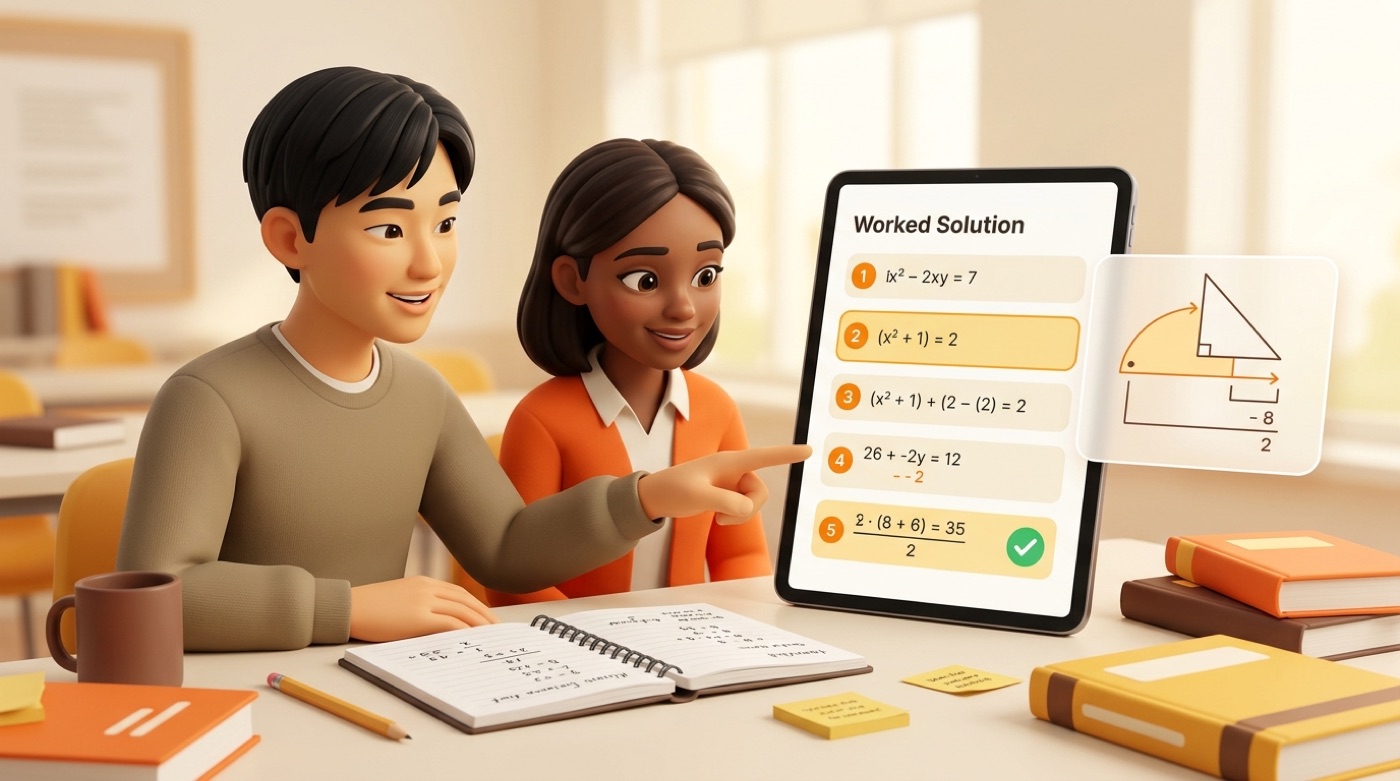
An AI-powered homework helper is an on-demand AI tutor: you type a question, or upload a photo or PDF of your worksheet, and it responds with a worked, step-by-step explanation rather than a bare final answer. The idea has roots in the older concept of an intelligent tutoring system — software that adapts to a learner and explains its reasoning — now supercharged by modern generative AI that can read handwriting, parse a textbook page, and hold a conversation about the material. Kai is this kind of helper: available around the clock, patient with follow-up questions, and built around understanding rather than a finished worksheet.
What students use it for
In practice, students reach for an AI homework helper for a fairly narrow set of jobs:
- Explaining a specific problem step by step when a lecture or textbook moved too fast
- Checking completed work for mistakes before turning it in
- Getting a plain-language explanation of a concept missed in class
- Prepping for a test or quiz with practice questions
Tools in this space tend to cover well over 100 subjects, from early grade levels through Master’s-level coursework — so the same helper that walks a ninth-grader through algebra can also explain a college-level chemistry problem:
| Subject area | Example topics |
|---|---|
| Math | Algebra, geometry, calculus, statistics |
| Science | Biology, chemistry, physics |
| Language | Grammar, essay structure, literature analysis |
| History | Timelines, source analysis, essay prep |
| Computer science | Debugging code, algorithms, syntax questions |

How an AI Homework Helper Works
Using one is less complicated than it sounds, and the flow is basically the same across most tools in this category. Type the question directly, or snap a photo of the worksheet or textbook page and upload it — the AI reads the image, identifies the concept being tested, and breaks the problem into steps it explains one at a time. If you’ve already attempted the problem, it checks your work and points out specifically where the reasoning went wrong, rather than just marking it incorrect. From there it can quiz you on the underlying concept or generate a similar practice problem so the explanation actually sticks.
Here’s the sequence in order:
- Ask — type the question or upload a photo/PDF of the problem
- The AI reads the input and identifies the underlying concept
- It breaks the problem into steps and explains each one
- It checks any attempt you’ve already made and flags where you went wrong
- It can quiz you or generate a similar practice problem to reinforce the concept
Most tools answer in roughly ten seconds and run 24/7, so there’s no waiting for office hours or a tutoring slot. That speed matters for one reason: a helper that just prints the final answer trains nothing, while one that asks guiding questions and reveals its steps builds actual understanding. That distinction — guided explanation versus a straight answer dump — is the design choice behind Kai, and it’s also the difference the research below measures directly.

Does AI Homework Help You Actually Learn?
The research on one-on-one help
One-to-one tutoring is one of the most effective interventions in education research. Benjamin Bloom’s classic finding, known as the 2 sigma problem, showed that students who received individual tutoring outperformed classroom peers by roughly two standard deviations — a gap large enough to move an average student into the top few percent of a traditional class. AI can’t fully replace a human tutor, but it does make step-by-step, on-demand explanation available to students who would otherwise get none of that individual attention.
The gap between AI approaches shows up in the numbers too:
| Approach | What it does | Learning outcome |
|---|---|---|
| Guided AI (Socratic-style) | Asks questions, explains steps, checks reasoning | Measurably higher student achievement (Stanford RCT, Tutor CoPilot, 2024) |
| Direct-answer AI | Returns a finished answer with no explanation | Weaker retention, minimal skill transfer |
A Stanford-led randomized controlled trial of 900 tutors and roughly 1,800 students found that when tutors used an AI copilot built to suggest guiding questions instead of handing over answers, students were 4 percentage points more likely to master topics — with the largest gains, 9 percentage points, among students working with less-experienced tutors. That gap tracks with how students are already behaving on their own: 70% of teens report using generative AI tools, according to Common Sense Media (2024) — meaning the practical question for most families isn’t whether students will use AI, but whether the tool they’re using is built to teach or just to answer.
The catch: overreliance
None of this makes AI homework help automatically good for learning. Leaning on AI to produce answers instead of doing the thinking yourself risks real learning loss in problem-solving, research skills, and critical thinking. AI can also be wrong, incomplete, or misleading, so its explanations are worth double-checking against your notes or textbook rather than trusted blindly. The U.S. Department of Education has emphasized keeping humans — teachers and learners — “in the loop” when AI is used in instruction, rather than letting a tool make the decisions. The tool works when it supports your effort, not when it replaces it.
A few signs you’ve drifted from learning into overreliance:
- You submit an AI explanation as your own work without reading it closely
- You ask for the answer first instead of attempting the problem yourself
- You couldn’t redo a similar problem without the tool open
Homework Help vs. Cheating: Where’s the Line?
The simple test
If the AI does the thinking and you submit its output as your own, that’s cheating; if it explains, quizzes you, or helps you find your own mistake, that’s learning. Universities frame this distinction as “authorized” versus “unauthorized” AI assistance. Northern Michigan University’s Center for Teaching and Learning lists generating essays, solving homework problems to submit as your own, and producing exam answers as clear examples of unauthorized use.
Ensure that your course syllabus and university guidelines explicitly state the boundaries for AI use in assignments.
NMU Center for Teaching and Learning
That advice cuts both ways: the boundary isn’t fixed by the AI tool, it’s set by your teacher and your syllabus, which means the same AI homework helper can be perfectly fine in one class and off-limits in another. A few examples of where that line usually falls:
- Authorized: asking AI to explain a worked example, then solving the graded problem yourself
- Authorized: using AI to check finished work and explain a mistake you already made
- Unauthorized: having AI generate an essay or written response you submit as your own
- Unauthorized: pasting exam or quiz questions into AI to get answers to hand in
How to keep it honest with an AI homework helper
Using homework help with AI the right way is mostly a matter of habit, not willpower. Ask “why” instead of “what’s the answer,” so you’re prompting for reasoning rather than a result. Use the tool to check work you’ve already completed rather than to generate it from scratch. Cite AI use when your class requires disclosure — plenty of syllabi now ask for exactly that. This is exactly how Kai is built to be used: it nudges you toward the reasoning behind a problem, not the shortcut past it.

What Kai Can Help You With
Four ways to use it
- Explain it. Get a step-by-step walkthrough of a tough problem, broken into the individual reasoning moves instead of a single jump to the answer.
- Check it. Hand over work you’ve already finished and get specific mistakes flagged before you turn it in, not just a right-or-wrong verdict.
- Understand it. Ask for a plain-language explanation of a concept you missed in class, without the jargon a textbook chapter might bury it in.
- Prep for it. Generate practice questions and get quizzed on material before a test, so the explanation turns into something you can actually recall under pressure.
Across all four, the same breadth applies — math, science, language, history, computer science, and more — and it’s there whenever you need it, not just during a tutoring slot or office hours.
Frequently Asked Questions
- What is AI powered homework help?
It’s an AI tutor that explains problems step by step, checks your work, and helps you understand concepts — online, on demand, without waiting for a scheduled tutoring session.
- Is using AI for homework cheating?
Not by itself. It’s cheating if the AI does the work and you submit it as your own; it’s learning if it explains and checks your reasoning. Always follow your teacher’s or syllabus’s specific policy on AI use.
- Does AI homework help actually help you learn?
Yes, when it’s guided — step-by-step explanation and practice build real understanding. A Stanford-led randomized trial found tutors using an AI copilot built around guiding questions, not direct answers, produced measurably better student achievement. Overreliance on answers alone does not build the same skills.
- How does an AI homework helper work?
You type a question or upload a photo or PDF of the problem, the AI identifies the concept, breaks the solution into steps and explains each one, checks any work you’ve already done, and can quiz you or generate similar practice problems.
- Is AI homework help free?
Many tools, including AI homework help online with Kai, offer free access to get started. Some advanced features or higher usage limits may be paid depending on the tool.
- What subjects can AI homework help with?
Math, science, language, history, computer science, and more — typically over 100 subjects spanning early grade levels through Master’s-level coursework.