
The AI Homework Helper for College Students That Explains, Not Cheats
Between lectures, labs, and back-to-back deadlines, the real question is rarely «what’s the answer» — it’s «why does this work, and how do I get there myself.» Good AI homework help doesn’t hand you a solution to copy; it walks you through the reasoning until it clicks. That is the whole idea behind Kai, an AI homework helper built to explain problems step by step, check your finished work, and get you ready for exams.
It also draws a clear line. Academic integrity — what the International Center for Academic Integrity describes as a commitment to honesty, trust, fairness, respect, responsibility, and courage — sits at the center of college coursework. Kai is here to help you understand and learn, not to do your homework for you.

What an AI Homework Helper Actually Does for College Students
An AI homework helper is not an answer machine; it is closer to a patient tutor who happens to be available at 2 a.m. The idea is old — researchers have built intelligent tutoring systems since the 1970s — but modern AI powered homework help finally makes that one-on-one guidance instant and affordable. A dedicated AI homework helper like Kai gives you four things a plain search engine never will.
| What Kai does | What it looks like | Why it helps you learn |
|---|---|---|
| Explains step by step | Breaks a problem into stages and says why each one follows | You see the logic, not just the last line |
| Checks your work | Reviews your attempt and flags where it went wrong | You fix your own thinking |
| Builds understanding | Reworks the underlying concept with examples and analogies | You can solve the next problem too |
| Preps you for tests | Turns your material into practice questions and quizzes | You walk into the exam ready |
Explain a problem step by step
When you ask Kai a question, it shows the path, not just the destination. Each step comes with a short reason — a substitution, a sign change, a rule of grammar — so the «why» is visible. That mirrors how a strong tutor works: understanding the reasoning behind every problem is what turns a one-time answer into a skill you keep.
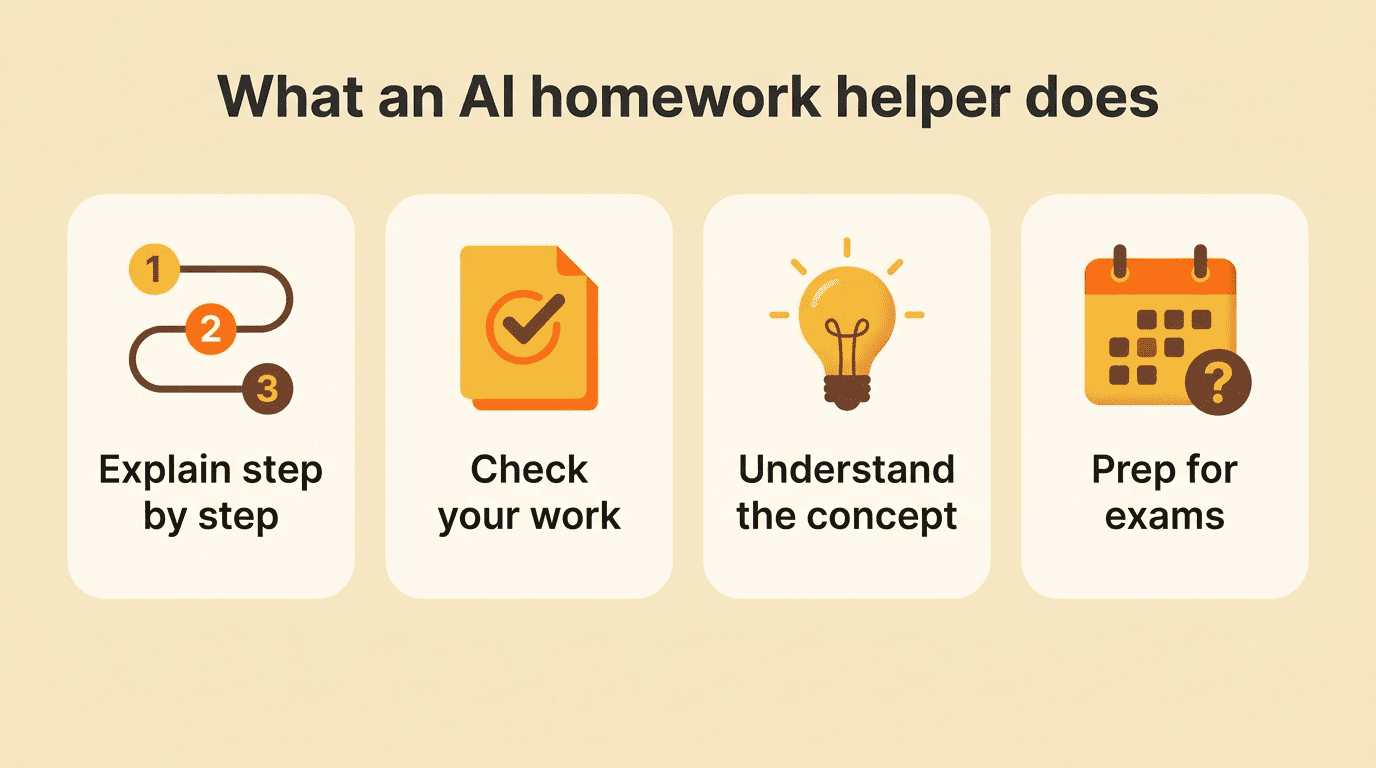
Step-by-step explanation is the core of good AI homework help. Reading a finished solution rarely sticks; following the reasoning while you rebuild it yourself does.
Check your finished work and catch mistakes
You solve the problem, then hand it to Kai to review. Instead of quietly replacing your answer, it points to the exact step where things slipped — a dropped negative, a skipped unit conversion, the wrong formula for the situation. That kind of feedback is much closer to what a human tutor offers than to copying an answer key.
Help you understand the concept behind the assignment
A single problem is never the real goal; the concept is. Kai can pull the underlying idea out of your own lecture notes or slides, restate it in plain language, and ask you a guiding question to check whether it landed. Grounding help in your actual coursework — the way a personal AI tutor should — keeps answers relevant to your class, not to some generic textbook.
Prep you for tests and exams
From material you have already covered, Kai can generate practice questions, flashcards, and short quizzes, then keep a history you can revisit before an exam. That review loop is where an AI homework helper online quietly does its best work — not the night-before scramble, but steady practice across the term.
Understand, Don’t Cheat: Academic Integrity in College
Here is the part every college student should read slowly, because the stakes are higher than in high school. Most universities publish an honor code, and AI rules now vary from one syllabus to the next. According to Cornell’s Center for Teaching Innovation, the difference between a learning aid and a violation comes down to a simple test: whether the tool supports your own thinking or replaces your effort and critical thinking.
Academic integrity is a commitment, even in the face of adversity, to six fundamental values: honesty, trust, fairness, respect, responsibility, and courage.
International Center for Academic Integrity
Kai is designed to keep you on the right side of that line. It explains, checks, and quizzes — it does not exist to write your essay or complete a graded problem set so you can submit it as your own. Used that way, an AI homework helper is no different in principle from a calculator, a study group, or the tutoring center: a support for learning, not a substitute for it.
Where the line really is
The boundary is easier to hold once you name it plainly:
- On the right side: using Kai to understand a concept, to check your own solution, to plan an essay, or to build practice questions for an exam.
- Over the line: pasting a generated answer into a graded assignment without your own contribution — and without disclosing it when your course requires that.
- Always: matching your use to the specific rules of the class, since two professors on the same campus can set opposite policies.
The same logic applies whether you are debugging code, outlining a history paper, or working through AI science homework help for a chemistry lab. Kai helps you understand the material; you produce the work.
Disclose and follow your course policy
When you are unsure, ask the instructor and disclose your use of AI if the syllabus asks for it. Transparency removes almost all the risk, and most faculty respond well to a student who checks first. The goal is never to game the policy — it is to learn the material honestly and be able to prove you did.
How to Use Kai the Right Way: a Workflow That Builds Understanding
A tool helps exactly as much as your habits let it. Decades of learning-science research point the same way: active recall and spaced review beat passive rereading by a wide margin. A review in Nature Reviews Psychology summarizing the evidence on spacing and retrieval practice found these two strategies among the most reliable ways to make knowledge stick — and one meta-analysis drew on studies covering 169,179 participants to reach a similar conclusion.
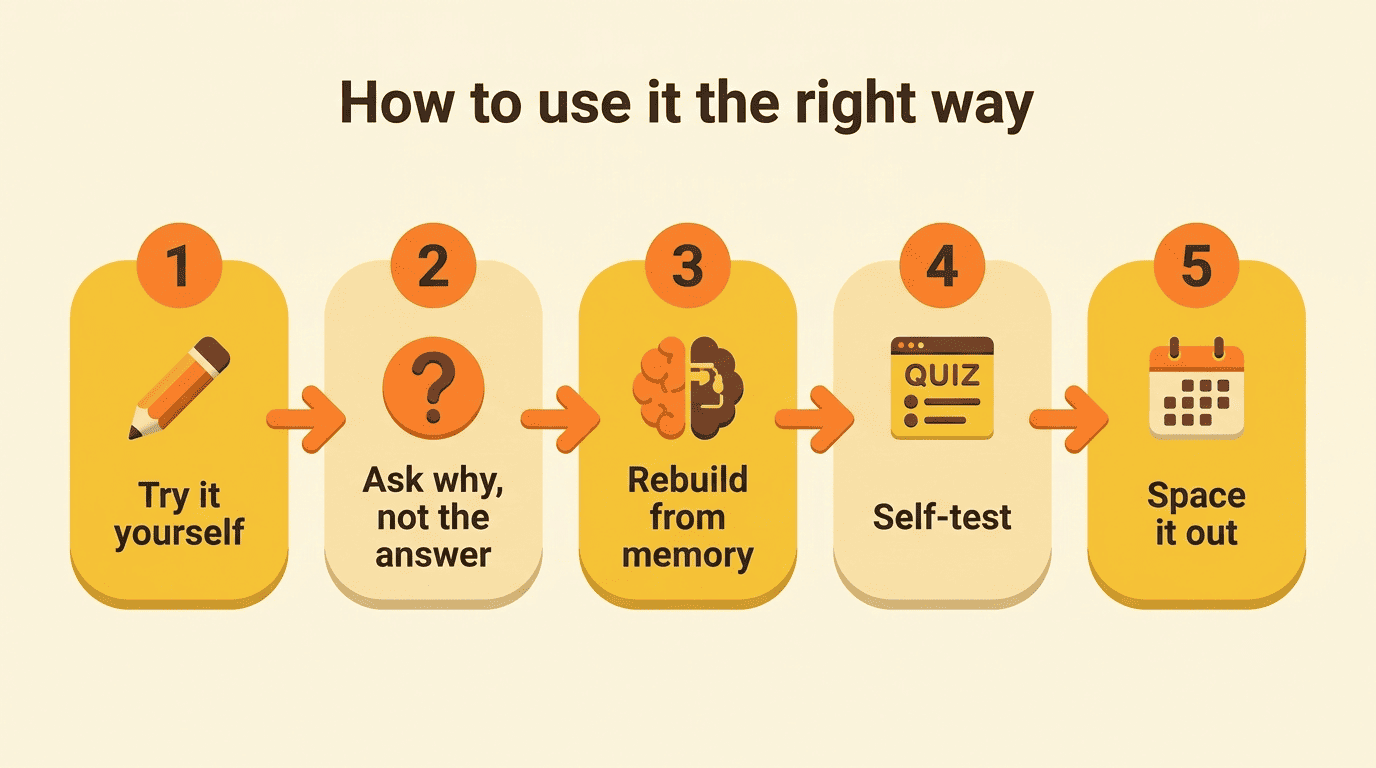
Here is a five-step routine that turns Kai into a study partner instead of a shortcut:
- Try the problem yourself first. Struggle for a few minutes — that effort is what retrieval practice rewards.
- Ask for the reasoning, not the answer. Prompt Kai with «explain why this step works» or «show me another method.»
- Rebuild it in your own words. Close the screen and redo the problem from memory.
- Self-test with fresh questions. Ask Kai for two or three similar problems and solve them cold.
- Space it out. Come back a day or two later and test yourself again, well before the exam.
This order matters. If you start at step two, you are copying; if you start at step one, you are learning, and Kai simply removes the frustration that used to make you give up.
Subjects and Coursework Kai Handles at the University Level
College work is broad, and so is the coverage of a capable AI homework helper — the leading tools list 100+ subjects spanning STEM, business, law, and the humanities. You can type a question, paste a passage, or upload a photo or PDF of a problem set, and Kai works from your own material rather than a generic template.
| Area | Example coursework | How Kai helps |
|---|---|---|
| Math & statistics | Calculus, linear algebra, probability | Step-by-step derivations, checks your solution |
| Physical & life sciences | Physics, chemistry, biology labs | Explains formulas and lab reasoning in context |
| Computer science | Algorithms, Python, data structures | Walks through logic, helps you debug your own code |
| Writing & humanities | Essays, history, philosophy | Feedback on structure and argument — not a ghostwriter |
| Social sciences | Economics, psychology, sociology | Clarifies concepts and interprets your readings |
STEM: math, science, and problem sets
For quantitative work, Kai breaks each problem into stages and keeps the relevant formula or theorem visible, so you can follow the derivation rather than memorize a result. Upload a photo of a messy problem set and it reads the question, then explains the route to the solution one step at a time.
Because it grounds answers in the exact problem in front of you, the help stays specific — the difference between «here is how logarithms work» and «here is the step you missed in problem four.»
Writing, humanities, and social sciences
In writing-heavy courses, the healthy use is narrower and more valuable: Kai can help you understand a dense source, test whether your thesis holds, and react to a draft you wrote. The point is to sharpen your own argument, not to outsource it.
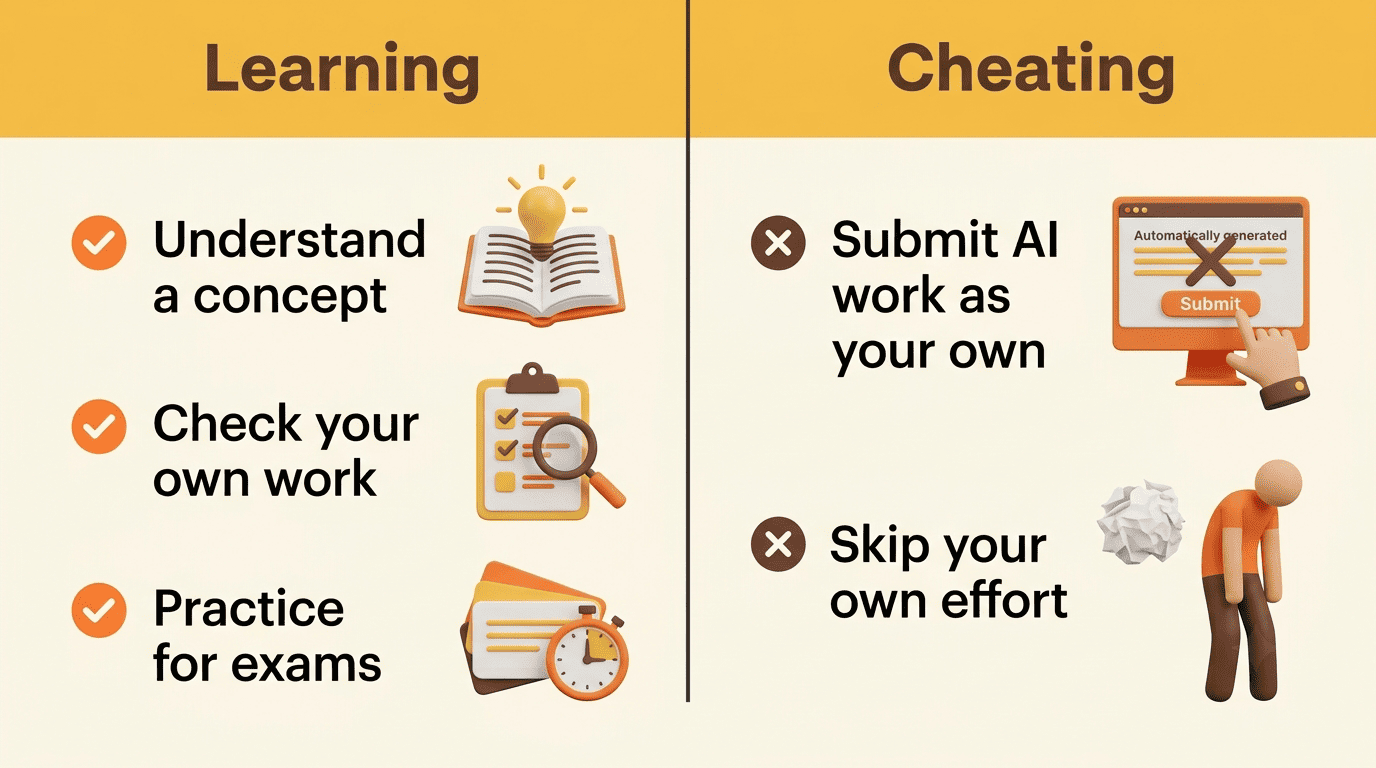
It will not — and should not — produce the essay for you. Feedback that improves your own writing keeps the work yours while still making it better.
Works with your own materials
Upload notes, slides, or a reading, and Kai answers from that context; some study platforms even connect to learning systems like Canvas, Blackboard, and Brightspace. Course-grounded answers are simply more accurate than generic ones, because they speak to your professor’s framing, not the internet’s.
Accuracy, Limits, and How to Choose an AI Homework Helper
No AI is infallible, and pretending otherwise is how students get burned. Even strong models can slip on long multi-step math or invent a citation, so the last step is always yours.
Verify before you trust. Treat every answer as a draft to check, not a fact to submit. Re-run the reasoning yourself, plug the result back into the original equation, and compare it against your lecture notes or textbook. Catching the tool’s occasional mistake is, conveniently, one of the best ways to prove you actually understand the material.
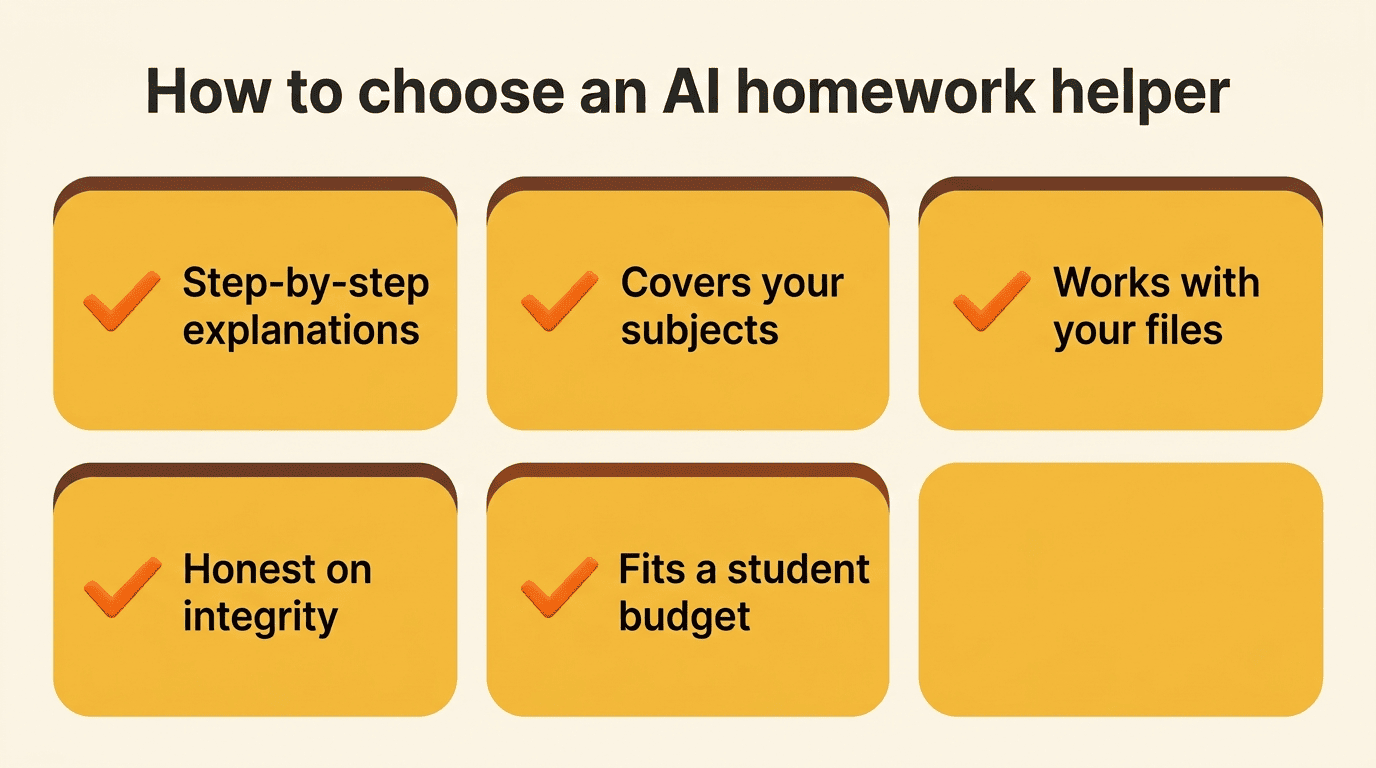
Know what to look for when choosing. Not all tools are built to teach; some are built to answer. When you compare options, weigh these:
- Genuine step-by-step explanations, not just a final answer
- Coverage of the specific subjects you take
- The ability to work from your own files and notes
- An honest stance on academic integrity
- Pricing that fits a student budget — free, no-sign-up options exist, but explanation quality matters more than price
Match the tool to your goal. If your goal is a better grade this week, any solver will tempt you; if your goal is to still know the material at the final, choose the one that makes you do the thinking. Kai is built for the second kind of student.