
AI Tutor for Homework Help: Understand the Work, Don’t Just Copy the Answer
It’s 11pm, the problem set is due at 8am, and no human tutor is awake to help. A good AI homework help tool — like Kai — is a patient tutor that walks you through the reasoning step by step so the concept finally clicks.
The point of a tool like Kai isn’t to hand you a finished answer — it’s to help you understand the work well enough to do it yourself next time. That idea isn’t new: decades of education research on one-to-one tutoring, the kind behind the Socratic method that Khan Academy has championed for years, shows that personal, paced guidance changes how well concepts stick. An AI tutor for homework help just makes that kind of attention available whenever you need it, not only during office hours.
What an AI Tutor for Homework Help Actually Is
An AI tutor for homework help is software — usually built on a large language model — that acts like a personal AI tutor: you bring it a question, and instead of just spitting out a number, it works through the problem alongside you. It belongs to a broader category education researchers call an intelligent tutoring system — think of it less as an answer key and more as an AI learning companion that’s read the textbook and has infinite patience. A few traits set a genuine AI tutor apart from a plain answer generator:
- It explains the reasoning, not just the result
- It adapts the pace and difficulty to your level
- It asks guiding questions instead of only stating facts
- It’s available any time, not on a fixed schedule
A patient 1:1 tutor, available any hour
Unlike a static answer key, an AI tutor like Kai holds a back-and-forth conversation, adapts to your level, and is available 24/7. Students consistently say what they value most is speed and access — a real answer in seconds, any time of day, rather than waiting for a scheduled session. Many tools respond in a matter of seconds and cover material from first grade through graduate school, so the same AI homework helper that explains long division can also walk a college student through a statistics proof.
That matters most in the moments a human tutor simply isn’t reachable — a Sunday night, a snow day, a question that pops up at 6am before the bus. A homework helper that never closes turns those dead-end moments into a five-minute fix instead of a missed assignment.
Built on the idea of one-to-one tutoring
The value proposition traces back to a well-known finding in education research: students who get individual tutoring dramatically outperform peers who only get classroom instruction — a gap researcher Benjamin Bloom called the «2 sigma problem». Intelligent tutoring systems, a field of educational software that predates modern AI by decades, tried to approximate that effect with computers. Large language models are the first technology patient and flexible enough to actually deliver something close to it at scale, for free or nearly free, to any student with a phone.
No single AI tutor replaces a great human teacher, and it isn’t trying to. What it replaces is the gap between classroom instruction and the one-on-one attention that most students never get outside a private tutor’s hourly rate.
How It Explains Homework Step by Step
Good tools don’t stop at the final number — they show the reasoning that got there. A worked-through explanation, broken into ordered steps with the relevant rule or formula named at each stage, is what separates a real AI teaching assistant from a search-engine answer box.
From one problem to the underlying method
You paste in a question, upload a PDF, or snap a photo of the textbook page, and the tutor breaks it into ordered steps, names the rule or formula each step uses, and explains why — so you can repeat the same method on the next problem instead of memorizing one answer. That input flexibility matters on a busy night: an AI homework helper that reads a photo of messy handwritten work saves you from retyping an entire page of algebra. Common input formats include:
- Typed or pasted text of the question
- A PDF of a worksheet or textbook chapter
- A photo taken straight from a phone camera
- A screenshot from an online assignment portal
Most students don’t need every step of every problem explained forever — they need the method to transfer. A tutor that highlights the specific theorem or formula behind each step, rather than just showing arithmetic, is teaching pattern recognition, which is the actual skill being graded on a test.
Guided questions, not just the final number
Strong tutors use a Socratic style — they ask a leading question, wait for your answer, and nudge rather than dumping the solution. Khan Academy describes its own AI tutor, Khanmigo, as designed to guide learners to find the answer themselves rather than hand it over. That distinction — a nudge versus a handout — is the difference between memorizing an answer and owning the method behind it.
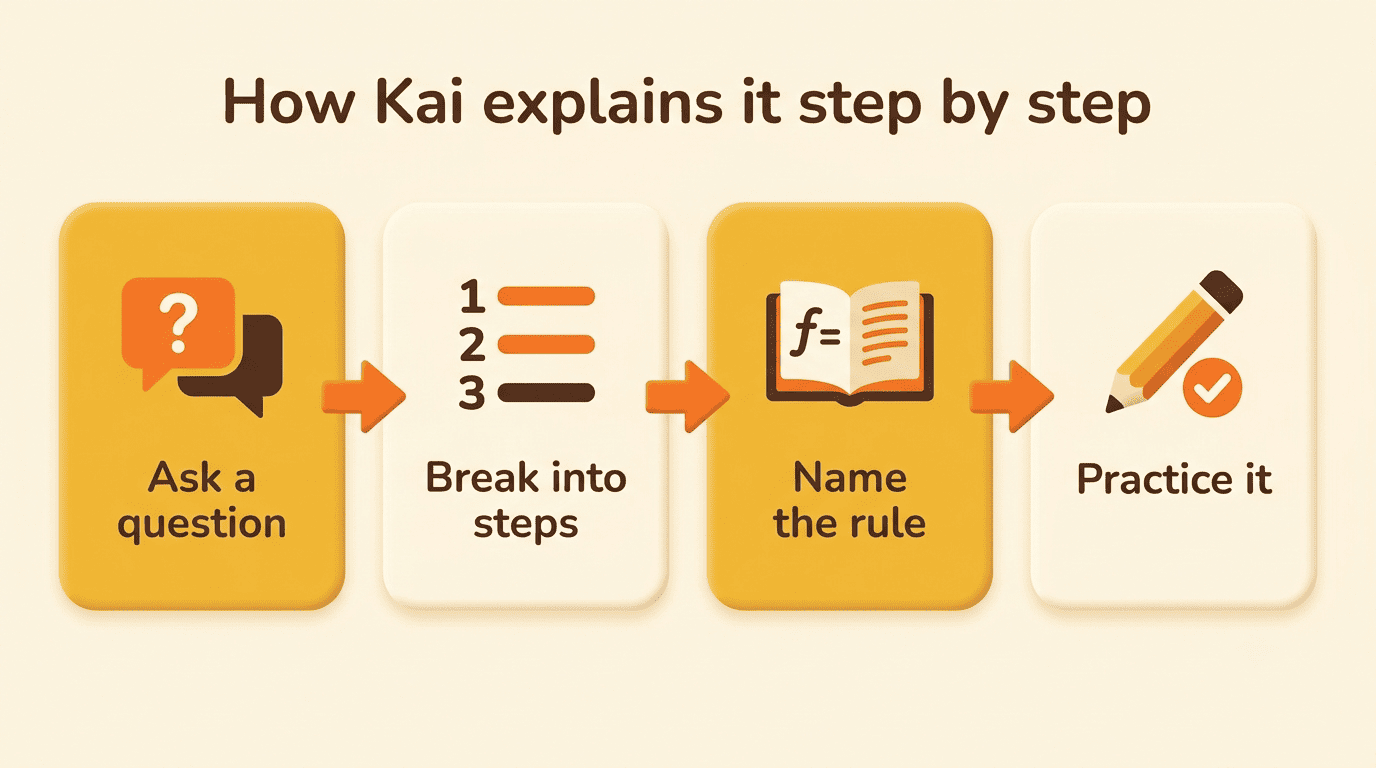
It can feel slower in the moment — a question back instead of an instant number — but that friction is doing the actual teaching. A tutor that only hands over results trains you to depend on it; one that asks «what have you tried?» trains you to think.
One of our principles is it’s not about cheating. It’s about helping you and supporting you.
Sal Khan, founder of Khan Academy
Is Using an AI Tutor for Homework Cheating?
This is the question every student and parent asks eventually, and the honest answer is: it depends what you do with it. Used to understand, an AI tutor for homework help is learning support. Used to skip the thinking entirely, it isn’t.
The honest line: understand vs. hand in
Using a tutor to understand a concept, check your reasoning, or find your mistake is learning — no different from asking a human tutor or a teacher during office hours. Pasting the AI’s output straight into your submitted assignment is where it crosses into academic dishonesty. Most university academic-integrity policies draw the line at whose thinking actually ends up on the page, not at whether a student used any outside help at all. Purdue University’s Office of Student Rights and Responsibilities, for example, defines academic dishonesty around submitting work that isn’t genuinely your own — the tool you used to get there matters less than whether the final work reflects your own understanding.
| Learning use | Cheating use |
|---|---|
| Asking why a step works | Asking only for the final answer |
| Checking your own solution for mistakes | Copying the AI’s solution into your submission |
| Getting a similar practice problem | Submitting AI text as your own essay |
| Reviewing a concept before a test | Using it during a closed-book exam |
The line usually isn’t about the tool at all — a calculator, a textbook, and a study group all sit on the same spectrum. What matters is whether the work you turn in reflects understanding you actually built.
How Kai is built to keep you honest
Kai explains, checks, and quizzes — it’s built to help you learn the material, not to function as a homework-for-hire service. The habit worth building is simple: let Kai walk you through the reasoning, then close the chat and write the final answer yourself, in your own words. Check your school’s specific AI policy too, since schools vary in what they allow, and when in doubt, ask a teacher directly.
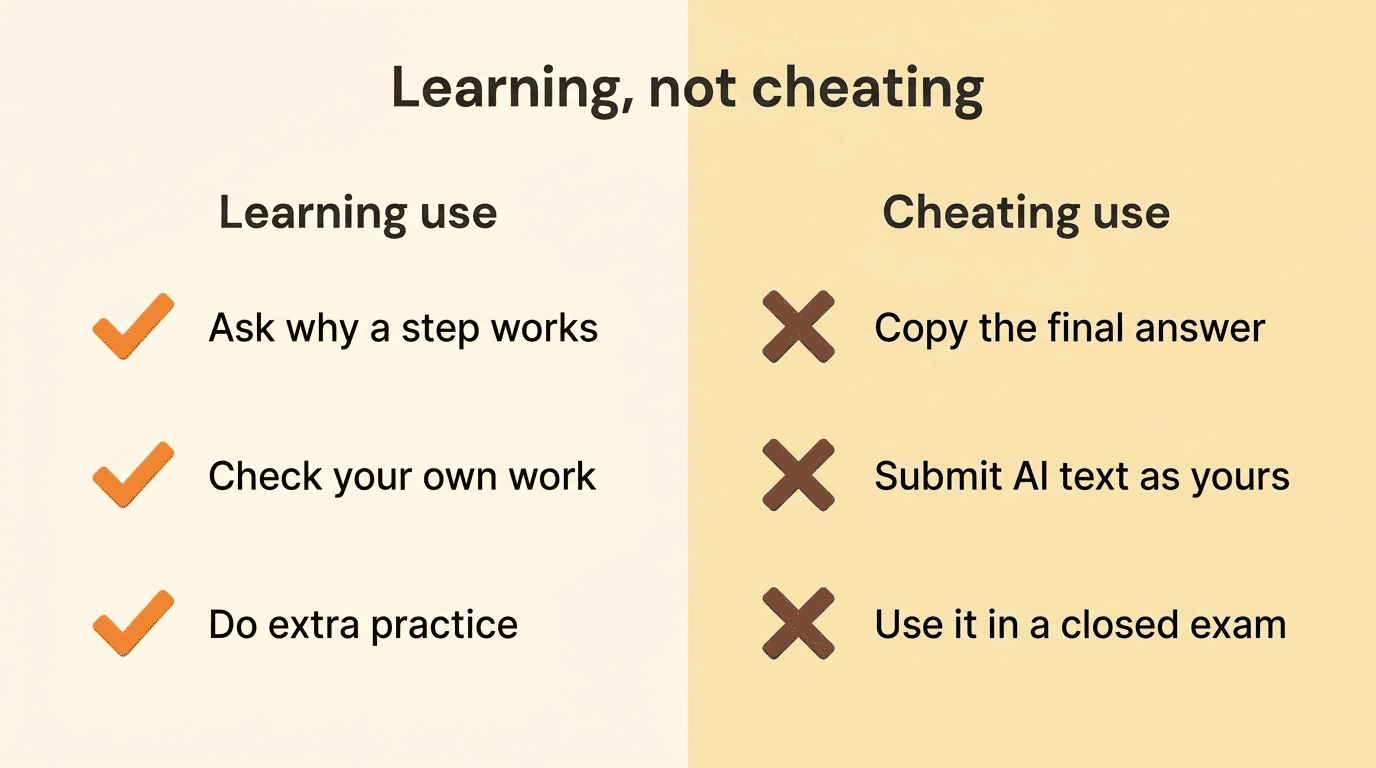
None of this requires a lecture every time you open the app. Treat Kai the way you’d treat a study partner who happens to know every subject — useful for getting unstuck, useless if you just copy what it says.
Subjects and Homework Types It Handles
A useful AI tutor for homework help isn’t limited to one subject — it needs to flex between a chemistry equation in the afternoon and an essay outline that night.
| Subject area | Typical homework types |
|---|---|
| Math | Algebra, geometry, calculus, statistics — step-by-step problem solving |
| Sciences | Chemistry, physics, biology — formula application and lab reasoning |
| Writing & humanities | Essay outlines, history reading comprehension, thesis brainstorming |
| Test prep | Practice questions, quizzes, flashcards, review sessions |
| Languages | Vocabulary practice, grammar checks, translation support |
Math and the sciences
Algebra, geometry, calculus, chemistry, physics, biology, statistics — this is where step-by-step explanation matters most, since one skipped rule can make the rest of the solution meaningless. AI tutors that highlight the specific formula or theorem behind each step turn a single solved problem into a repeatable method. If you’re working from your phone between classes, a lightweight homework help app that opens fast and reads a snapped photo beats digging out a laptop for a five-minute question.
These are also the subjects where students most often ask for the answer instead of the method — which is exactly where the Socratic nudge matters. A physics problem solved by pattern-matching a formula, without knowing why that formula applies, falls apart the moment the wording changes on the test.
Writing, humanities, and study skills
Outlining an essay, understanding a dense history reading, brainstorming a thesis statement, or getting structural feedback on a draft — this works best as coaching, not ghost-writing. The tutor asks what your argument is, points out where a paragraph wanders, and leaves the actual sentences to you. On the humanities and study-skills side, a homework helper typically supports:
- Essay outlining and thesis brainstorming
- Reading comprehension for history or literature
- Structural feedback on a draft, not rewritten sentences
- Flashcards and vocabulary practice for languages
- Quiz-style review across subjects
Writing help is the area students worry about most, and rightly so — a paragraph the AI wrote for you isn’t your paragraph. Used as a coach that questions your argument rather than a ghostwriter that finishes it, the same tool builds skill instead of replacing it.
Test Prep and Making Concepts Stick
Explaining a problem once is only half the job — the other half is proving you can do it again without help.
Practice, quizzes, and spotting your weak points
After explaining a concept, a good tutor generates similar practice problems and quizzes you on them. Active recall is one of the most evidence-backed study techniques in cognitive science: decades of research on retrieval practice, or the testing effect, consistently finds that testing yourself on material strengthens memory more than simply re-reading it. Kai turns a solved problem into a few practice variations so you can prove you can do it alone, rather than assuming you understood it because the explanation made sense at the time.

Spotting weak points matters as much as practicing strong ones. A tutor that tracks which question types keep tripping you up can steer the next quiz toward exactly those gaps, instead of drilling material you already know cold.
From «I got the answer» to «I could teach this»
The real test of understanding is explaining it back in your own words. Try a Feynman-style check: if you can re-explain each step to Kai without looking at the original solution, the concept is actually yours — not just something you recognized while reading along. Signs a concept has actually stuck include:
- You can restate the method without checking notes
- You can solve a slightly different version of the problem
- You can explain why a step works, not just that it does
- You don’t need the tutor for the next similar question
That last check is the one that matters on test day, when no tutor — human or AI — is sitting next to you.
How to Get Real Learning Out of an AI Tutor
The tool matters less than the habits you build around it. Used well, an AI powered homework help session builds skill; used carelessly, it builds dependence.
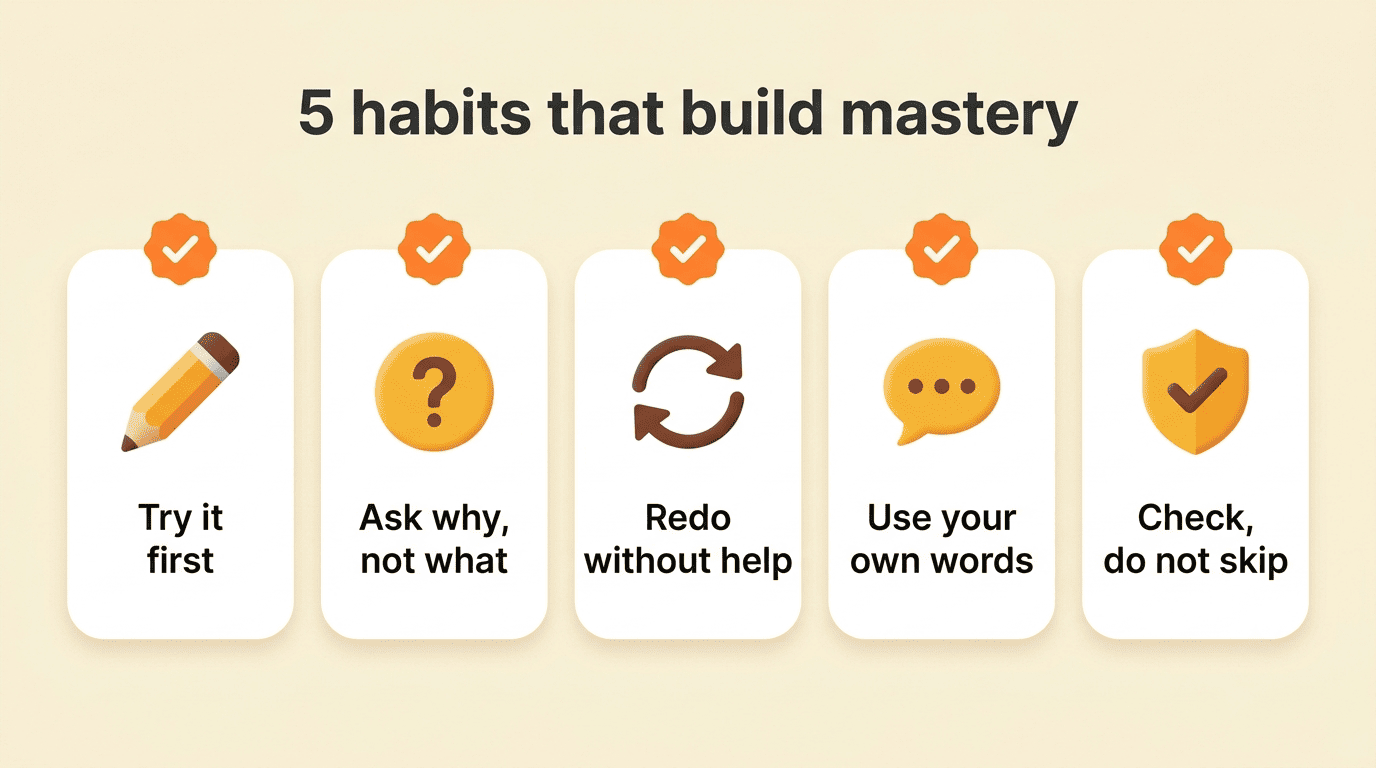
Five habits that turn help into mastery
- Try the problem first, even if you get stuck — struggling briefly before asking helps the eventual explanation stick.
- Ask «why,» not «what’s the answer» — push for the reasoning, not just the result.
- Redo the next similar problem without help to check whether the method actually transferred.
- Put the final write-up in your own words before you submit anything.
- Use it to check your work, not to skip the work — verify a completed attempt rather than outsourcing the attempt itself.
The U.S. Department of Education’s Office of Educational Technology has recommended keeping «humans in the loop» as AI tools enter classrooms — meaning students and teachers stay the ones making the real decisions, not the software. That’s the standard worth holding an AI homework helper to — including this one.