
AI Homework Helper: How to Understand Your Homework (Not Just Get Answers)
An AI homework helper is an AI study tool that reads your problem — typed or snapped as a photo — and walks you through the solution step by step, so you learn how to get the answer, not just what it is. According to Wikipedia’s overview of intelligent tutoring systems, software built to adapt to a learner and explain its reasoning has long been shown to help students more than a plain answer lookup does. Meet Kai, the AI homework helper that explains the «why» behind every step across math, science, and more.

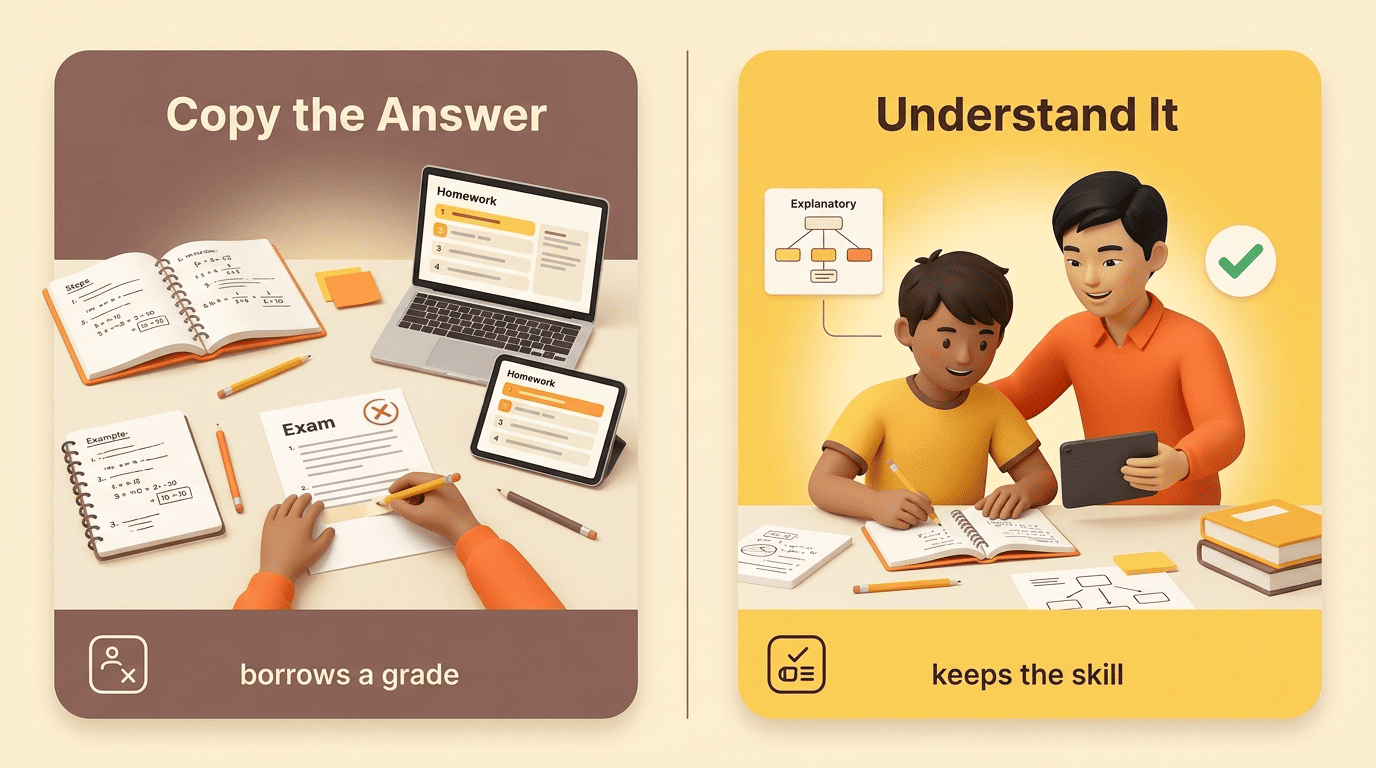
The best of these tools work like a patient tutor at 2 a.m. — free to start, no sign-up needed, ready for one tricky question or a whole review session. Used right, an AI homework helper builds understanding; used to copy answers, it just borrows a grade you didn’t earn.
What Is an AI Homework Helper?
A study tool, not an answer vending machine
An AI homework helper is a class of AI study tool — dozens of apps fit the description — that turns a homework question into a worked, step-by-step explanation instead of a bare final number. One competitor in the space, Edubrain, reports over 224,000 students a month using its free AI homework helper; the category is now mainstream, not a niche experiment. Whatever the brand, the promise is the same: type or upload a question, and an AI powered homework help tool answers with reasoning you can follow, not just a result to transcribe.
The tech under the hood
Most helpers pair optical character recognition (OCR) — to read a snapped photo or scanned PDF — with a large language model; some tools name GPT and Gemini specifically in their stack, plus a symbolic math engine for algebra and calculus. That combination is why you can photograph a scribbled equation on notebook paper and get back a typed, structured walkthrough instead of a guess. A private AI tutor built this way typically relies on:
- Computer vision / OCR to turn a photo or scan into readable text
- A large language model to reason through the steps and write the explanation
- A symbolic math engine to handle algebra, calculus, and equation-solving precisely
- A conversation layer that lets you ask follow-up questions about the same problem
How Does an AI Homework Helper Work? (3 Steps)
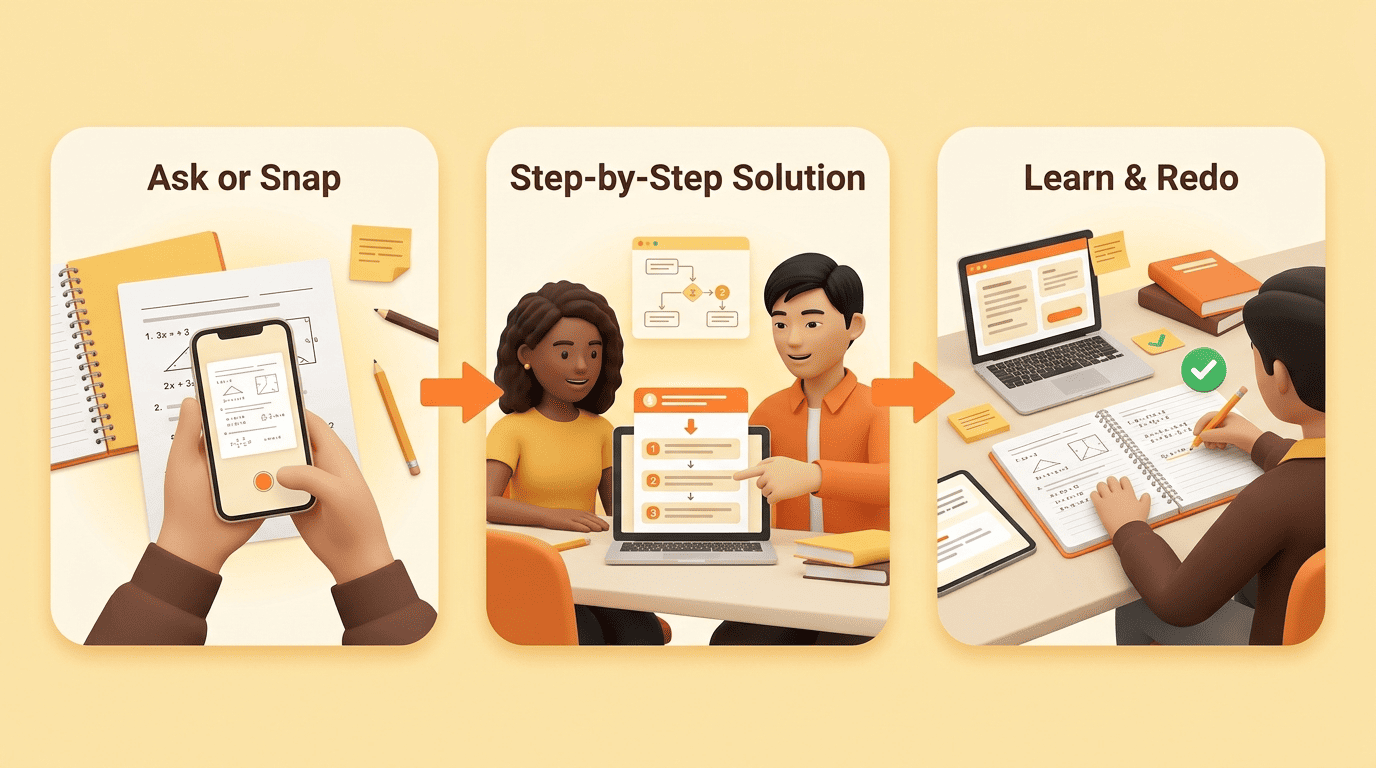
Getting from a stuck problem to an explained one takes three simple steps, and the same flow works whether you’re doing a single tricky question or reviewing for a test.
- Ask or snap. Type the question, paste it with Ctrl+V, drag in a PDF, or snap a photo of the page. Some tools even accept audio, and most take images, PDFs, and scans up to a size cap that varies by provider.
- Get the worked solution. The homework AI returns a step-by-step solution, usually within seconds — StudyMonkey, for instance, claims answers in 10 seconds or less. You see each step of the reasoning, not just the final number.
- Learn from it. Reread the reasoning, redo the problem yourself without looking, and ask follow-up questions like «why did you factor here?» Kai is built to answer the «why,» which is where the actual learning happens.
That third step is the one students skip and shouldn’t: rereading an explanation without redoing the problem yourself feels like studying, but it barely moves the needle on what you actually remember.
What Subjects Can It Help With?
Coverage varies by tool, but most AI homework helpers cluster around the same core areas before branching into electives and test prep:
| Subject area | Typical coverage |
|---|---|
| Math | Algebra, calculus, geometry, statistics |
| Science | Physics, chemistry, biology |
| Computer science | Python and other intro programming |
| Humanities | English, history, economics, languages |
| Test prep | SAT/ACT/GRE-style practice questions |
Math and STEM
Algebra, calculus, geometry, statistics, physics, chemistry, biology, and computer science (especially Python) tend to be the strongest areas for an AI homework solver, and most tools lead with math because it has clearly checkable steps — an equation either balances or it doesn’t. That makes math a good first subject to try if you’re deciding whether a given AI tutor is any good.
Humanities, languages, and test prep
Beyond STEM, coverage stretches to English, history, economics, and foreign languages, and some tools span dozens of subjects from elementary grades through graduate-level coursework, including SAT, ACT, and GRE-style practice. A few, like the nonprofit CK-12’s Flexi, deliberately stay limited to science and math rather than trying to cover everything.
Is Using an AI Homework Helper Cheating?
The honest line
The tool isn’t the problem — how you use it is. Using an AI homework helper to understand a method, check your own work, or study for a test is legitimate learning; pasting its answer onto an assignment and calling it yours is academic dishonesty, and most schools treat undisclosed AI-generated work the same way they treat copying. Northwestern University Libraries’ academic integrity guidance puts the line plainly:
Unauthorized use of ChatGPT or other Generative AI tools is considered cheating and/or plagiarism in Academic Integrity: A Basic Guide.
Northwestern University Libraries, Academic Integrity & Citing AI
That’s the gap between a study aid and a shortcut: one builds a skill you’ll still have on exam day, the other borrows a grade you didn’t earn.
How to stay on the right side
- Do the problem yourself first, then use the helper to check it
- Ask the helper to explain the one step you missed, not the whole problem
- Never submit AI-generated text or working verbatim as your own
- Follow your teacher’s or school’s stated policy on AI use
That short list is the difference between a study partner and a shortcut that leaves you unprepared when the real test has no AI homework helper next to it.
How to Use It to Actually Learn (Not Just Copy)
Turn answers into practice
After the helper explains a problem, close it and redo the problem from scratch on your own; then try a similar one without looking back. This is retrieval practice — pulling an answer out of memory rather than just rereading it — and a review published via the National Institutes of Health’s PMC research archive found that students who were tested on material showed improved long-term memory and understanding compared to students who simply reread the same material, well ahead of passive rereading that feels productive but usually isn’t.
Use it to find your gaps
When you keep missing the same kind of step, ask Kai to explain just that concept rather than re-explaining the whole problem every time. The goal is to need the AI study helper less over time as the gap closes — which is exactly what a good human tutor aims for too.
Accuracy and Limitations
Vendors advertise strong numbers for their AI homework solver — one competitor, AllMath, claims around 97% accuracy across roughly 3,000 AP-level math problems it was benchmarked against — but these are vendor-claimed figures, not independently audited ones. Because these tools run on large language models, they can still misread messy handwriting or produce a confident but wrong step, a failure mode Wikipedia’s entry on AI hallucination describes as generated content that is plausible-sounding but factually incorrect.
When to double-check
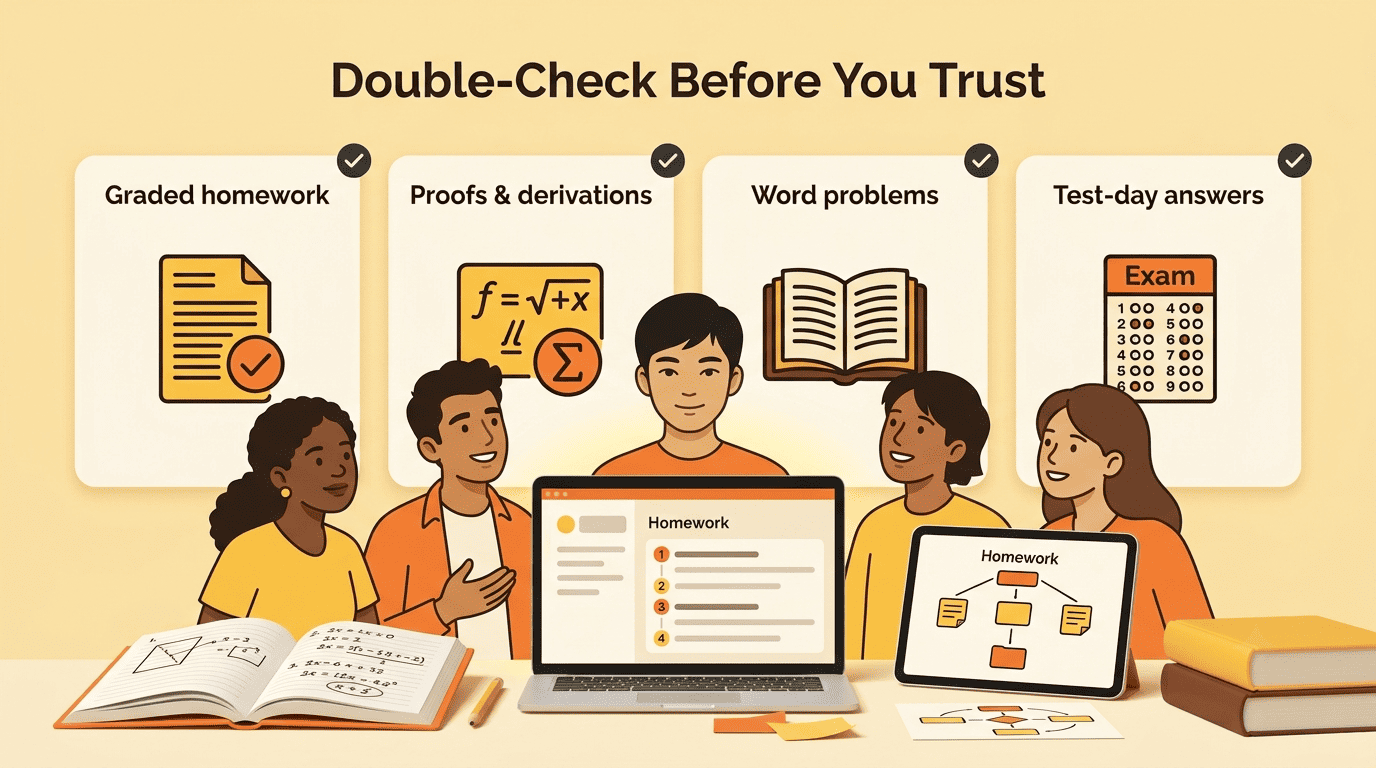
Treat the AI homework assistant as a smart first draft of the reasoning, not the final authority on it. Verify against your textbook or a second source whenever the stakes are higher than a quick practice run:
- Graded homework you’re about to submit
- Formal proofs and multi-step derivations
- Word problems, where a misread detail changes the whole setup
- Anything that will show up on a test with no AI homework helper allowed
How to Choose the Best AI Homework Helper
What to look for
Free limits vary a lot in practice — StudyMonkey’s free tier caps out around 3 questions a day, while GauthMath’s runs closer to 11 a day, and paid plans on most tools remove the daily cap — so check the fine print before you commit to one. When comparing options, prioritize:
- Step-by-step explanations over a bare final answer
- Coverage of your actual subjects, not just math
- A real free tier you can test before paying anything
- A clear, published privacy policy on uploaded photos and PDFs
| What to check | Why it matters |
|---|---|
| Step-by-step vs. final answer only | Determines whether you actually learn anything |
| Free tier limits | Some cap at roughly 3-11 questions/day before paywalling |
| Subject coverage | Not every helper covers humanities or test prep |
| Data/privacy policy | Some advertise zero data retention on uploads |
Why Kai
Kai is built around the learning-first idea: explain every step, check your work, help you prep for tests, and nudge you to think it through — not hand you a paste-ready answer. If you want an AI homework helper that treats «understand it» as the actual goal, that’s the whole point of homework help AI done right.

Under the hood, an AI homework helper doubles as a patient AI tutor for homework help, walking you through the reasoning one step at a time — which is exactly why it has caught on with college students juggling heavy course loads.