
AI Math Homework Help: Solve Any Problem Step by Step (and Actually Learn It)
Stuck on a math problem at 10 p.m. with no one to ask? A good AI homework helper walks you through the solution one step at a time, the kind of scaffolding the National Council of Teachers of Mathematics has long argued builds real understanding rather than rote answer-copying — so you finish tonight’s assignment and actually understand how it works.
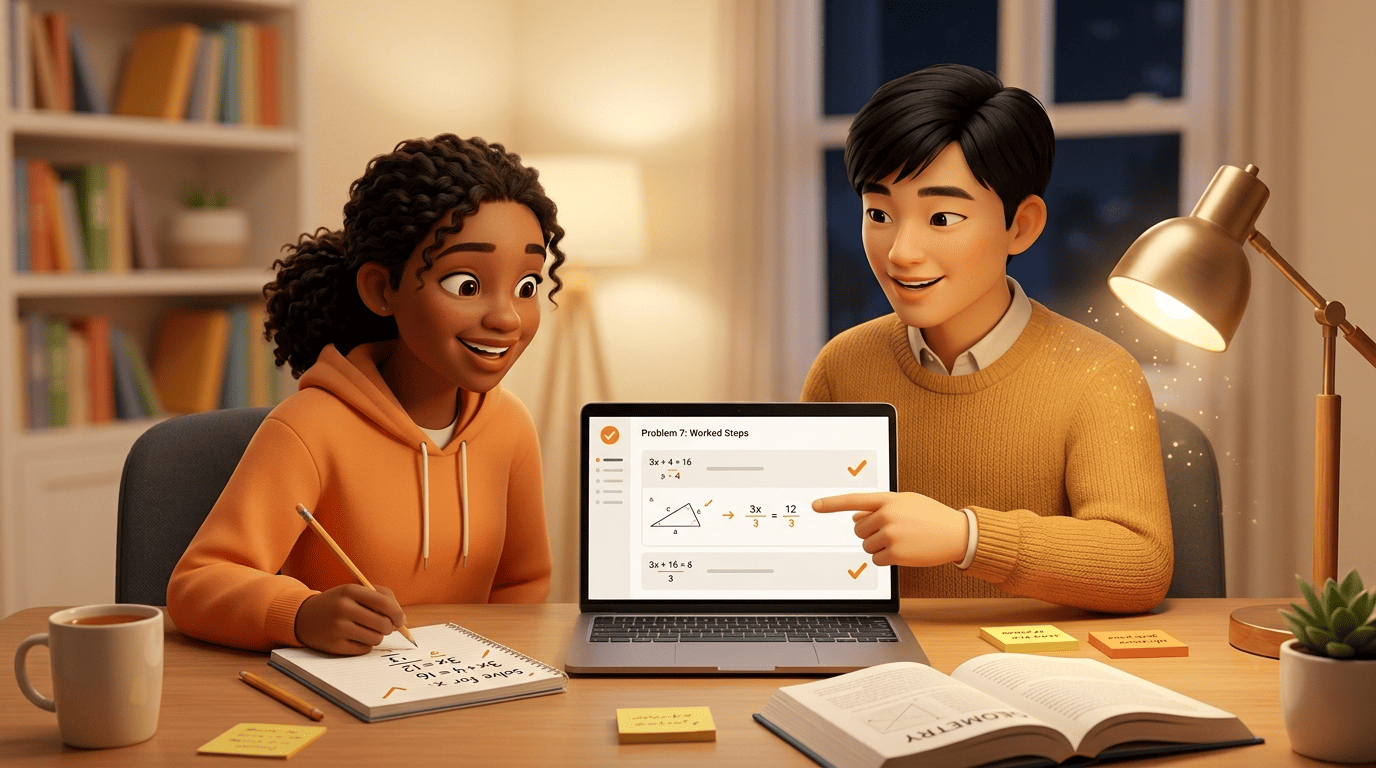
That second part matters. The best AI math homework help doesn’t hand you an answer to copy; it shows the why behind each step so the next problem gets easier. This guide covers how it works, what math it handles, and how to use it to learn instead of cheat.
What «AI Math Homework Help» Actually Means
From «answer machine» to step-by-step tutor
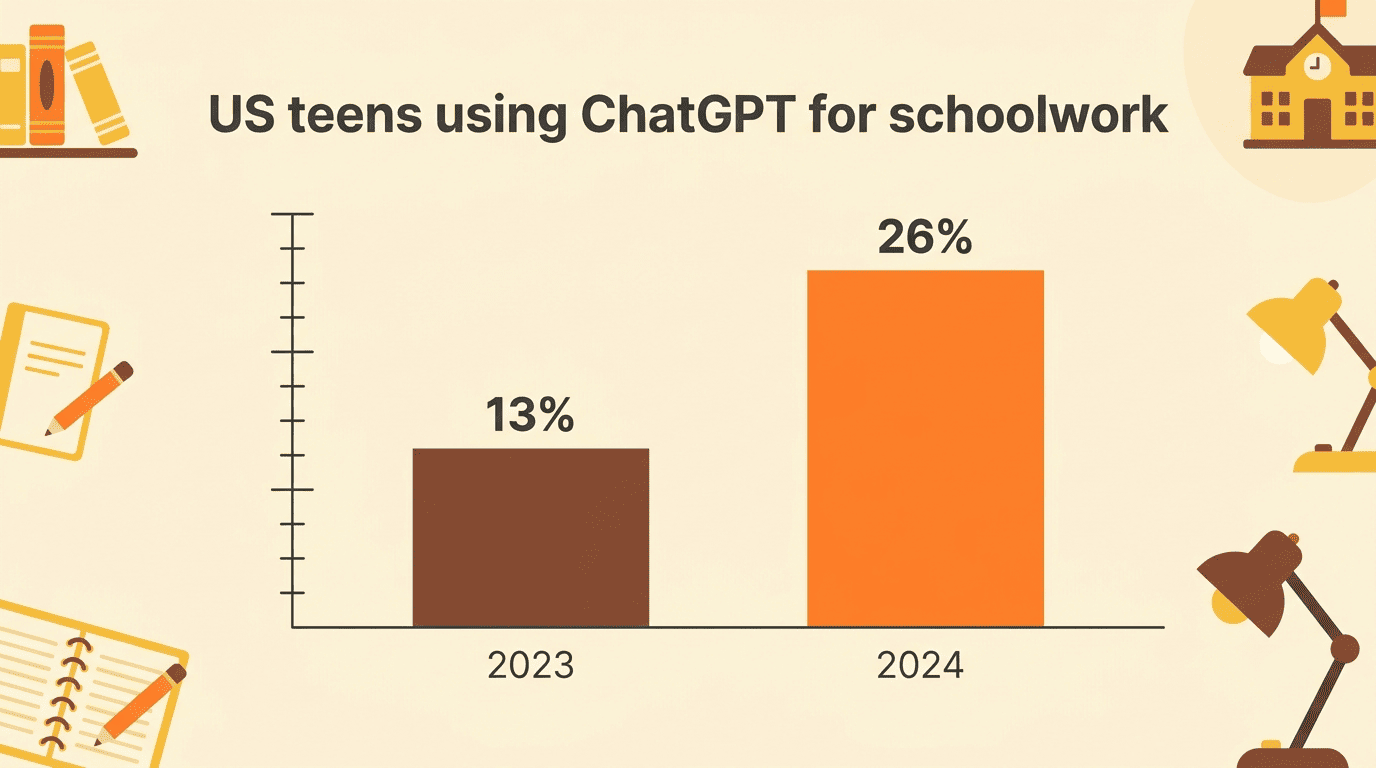
An AI math homework helper is a tool that reads a math problem — typed, spoken, or snapped as a photo — and returns a worked solution with each step explained. A Pew Research Center survey found that the share of U.S. teens who’ve used ChatGPT for schoolwork roughly doubled between 2023 and 2024, so leaning on AI for homework is mainstream now, not fringe. The difference between tools is whether they act like an answer machine (spit out the final number) or a tutor (guide you to it). Meet Kai, our AI homework helper, built to do the second.
What makes a helper good vs. risky
A helper is only as useful as the learning it leaves behind. Tools that just print the answer let you copy without thinking; tools that explain each step, ask what you already tried, and offer a similar practice problem build real skill. That is the line this whole guide keeps coming back to.
Look for these signs before you trust a tool with tonight’s homework:
- It restates the problem before solving it, so you can catch a misread
- It names the method, not just the answer (factoring vs. substitution, for example)
- It offers a follow-up practice problem instead of ending at the answer
- It flags when it’s unsure, rather than guessing with false confidence
| Type of tool | What it gives you | What it costs you |
|---|---|---|
| Answer machine | Final number, fast | No understanding, no transfer to the next problem |
| Step-by-step AI tutor | Worked steps + reasoning + follow-up Q&A | A few extra minutes per problem |
| Human tutor | Personalized pacing, real-time feedback | Cost, scheduling, not available at 10 p.m. |
How AI Solves a Math Problem Step by Step
The four moves behind every solution
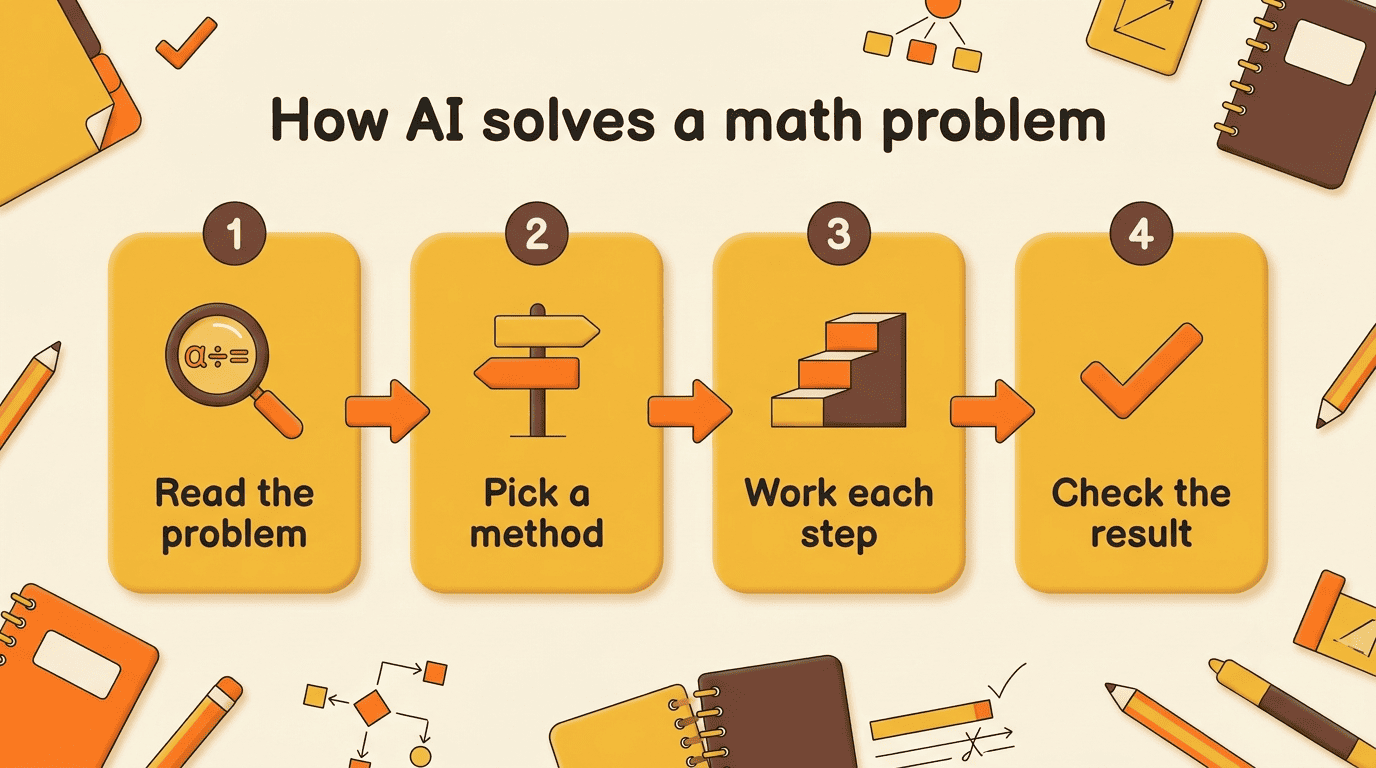
Behind a clean step-by-step answer, a strong AI math solver does four things: (1) reads and restates the problem, (2) picks a method (factor, isolate the variable, apply a formula), (3) works each step with a short reason, and (4) checks the result. Kai narrates all four so you can follow the logic, not just the arithmetic.
Here’s what that looks like in practice, from opening your problem to walking away with an answer you can defend:
- Enter the problem — type the equation, photograph the worksheet, or dictate a word problem.
- Let the AI restate it — confirm it read the numbers and the question correctly before anything else happens.
- Watch the method get named — factoring, substitution, a formula — so you know what approach is being used and why.
- Follow each worked step — one move at a time, with a short reason attached to it.
- Ask a follow-up — «why that step?» or «show it a simpler way» if something didn’t click.
- Check the result — does the answer’s size make sense, and does it match the method your teacher taught?
- Try a similar problem alone — the real test of whether it stuck.
Snap it, type it, or ask a follow-up
You can photograph a worksheet, type an equation, or describe a word problem in plain English. Three input methods cover almost every homework situation:
- Photo — snap a worksheet, textbook page, or handwritten equation
- Typed — paste or write out the problem, useful for online assignments
- Spoken or plain-English description — describe a word problem the way you’d explain it to a friend
Then the real value starts: you ask «why did we do that step?» or «can you show it a simpler way?» — the kind of follow-up a textbook can’t answer at 10 p.m.
What Math AI Can (and Can’t) Help With
Topics it handles well
From arithmetic and fractions to algebra, geometry, trigonometry, calculus, and statistics — modern math AI covers the full school-and-college range, including word problems. It’s especially handy on the topics students stumble on most: fractions, multi-step equations, and word problems. Tools like Photomath and Wolfram Alpha popularized photo-based solving years before chat-based AI tutors arrived, and the underlying idea — read the problem, show the work — is the same one Kai builds on with a more conversational, Socratic-method layer on top.
Where to double-check
AI can hallucinate — state a confidently wrong step with no warning, because it doesn’t fact-check itself. Treat every answer as a draft to verify, not gospel. Common red flags worth a second look:
- A step that skips explaining why, jumping straight to the next number
- A final answer that’s wildly larger or smaller than the numbers in the problem
- A method that doesn’t match what your teacher demonstrated in class
- Confident wording on a topic the tool has been shaky on before
A quick sanity check (does the answer size make sense? does it match what your teacher showed?) catches most errors.
| Topic | Great fit for AI help | Double-check this |
|---|---|---|
| Arithmetic & fractions | Yes — fast, reliable | Rounding on messy decimals |
| Algebra | Yes — strong on multi-step equations | Sign errors in long factoring chains |
| Geometry | Yes — good with formulas | Diagram misreads from photos |
| Calculus | Yes — derivatives, integrals | Edge cases, limits at discontinuities |
| Statistics | Yes — formulas and setup | Which test/formula actually applies |
| Word problems | Yes — breaking into steps | Whether it read the question correctly |
Is Using AI for Math Homework Cheating?
The simple rule
Here’s the clean line most schools draw: AI may help you learn the assignment, but it can’t do the assignment for you. Pasting AI’s output onto your homework and submitting it as your own crosses into academic dishonesty, a line the Wikipedia entry on academic integrity frames the same way: work submitted as your own has to actually be your own thinking. When a teacher bans AI outright, using it is cheating — full stop.
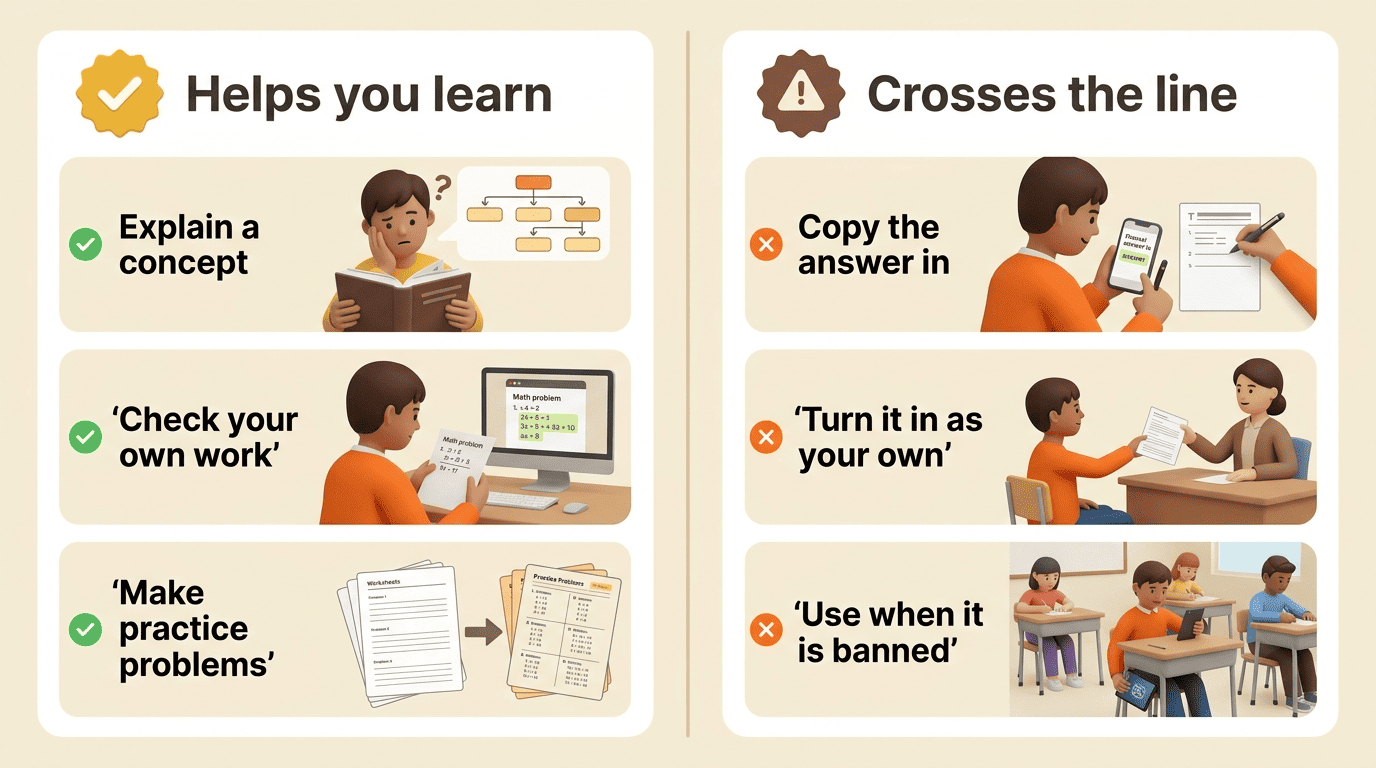
Generally OK:
- Asking AI to explain a concept you’re stuck on
- Checking your own finished work for errors
- Generating extra practice problems on the same topic
Generally not OK:
- Copying an AI-generated solution onto your homework and turning it in
- Using AI on an assignment or test your teacher has explicitly banned it for
- Submitting AI’s wording as your own explanation without understanding it
Learning beats copying — even for your grade
This isn’t just ethics; it’s outcomes. A randomized study of Turkish high school math students found that homework scores can rise even as closed-book exam performance falls — students who used an unrestricted AI chatbot scored better on practice problems but worse on the final exam than students with no AI access at all, because copying skips the practice tests actually measure. It’s a line of thinking mathematician George Pólya built his teaching around, often paraphrased as:
It is better to solve one problem five different ways, than to solve five problems one way.
attributed to George Pólya
Kai is built around that idea: it explains, questions, and checks, but it won’t write your homework for you.
How to Use AI to Actually Learn Math (Not Just Finish)
Ask for the first step only. Instead of «solve this,» try «explain the first step without solving the whole thing» — it forces you to work through the rest yourself, with a hint in hand instead of an answer.
Let it question you instead of tell you. Prompts like «ask me questions so I can figure it out» flip AI into Socratic mode, closer to a tutor than a calculator. Tutor CoPilot, a Stanford-developed AI system, was built on exactly this idea — it coaches human tutors in real time to ask better questions instead of just supplying answers, and in a randomized study of roughly 1,800 K-12 students, those whose tutors used it were measurably more likely to master the math concepts they were working on.
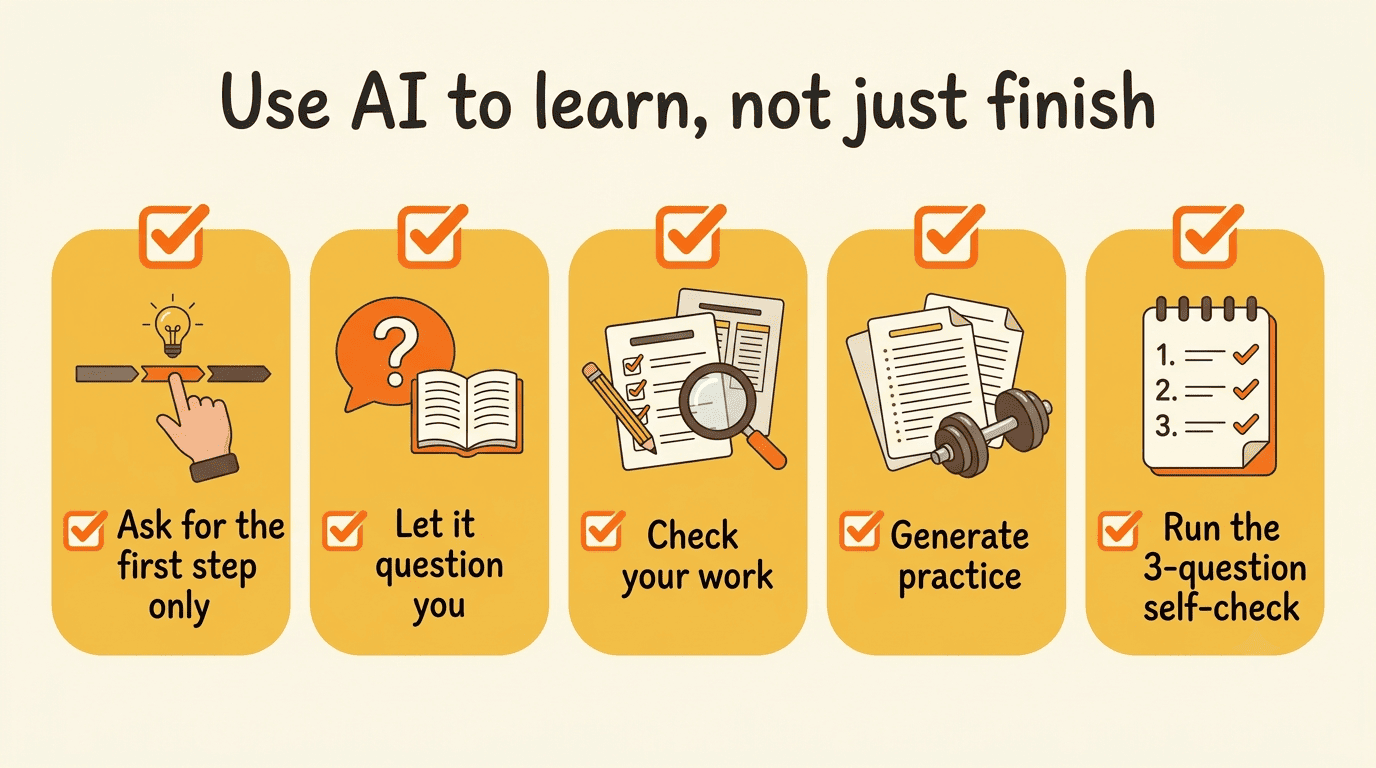
Check your work, don’t outsource it. Solve the problem your own way first, then say «I got X — check my work and point to where I went wrong.» You get the correction without skipping the attempt.
Generate practice, not homework. Ask for a similar problem with different numbers once you understand the original — that’s how the skill actually transfers to a test.
Run the three-question self-check before you trust an answer. Does it match what my teacher taught? Can I explain it without the AI? Can I verify it myself? If all three are yes, you’ve learned it — not borrowed it.
Stuck on a single equation? You can type it out for the AI homework solver or simply scan the problem with your phone and get a worked, step-by-step explanation you can actually learn from.