
AI Science Homework Help: Understand Chemistry, Physics & Biology Step by Step
Stuck on a titration problem at 10 p.m. with no one to ask? AI powered homework help puts Kai in your corner — an AI study buddy that walks you through chemistry, physics, and biology problems one step at a time, according to how the National Science Teaching Association recommends students build conceptual understanding rather than memorize isolated answers.

The goal isn’t to hand you an answer to copy — it’s to help you see how the answer is built so you can solve the next one yourself. That distinction is what separates a study tool from a shortcut.
What AI Science Homework Help Actually Does
An AI science homework helper reads your problem, restates it in plain language, and works through it the way a patient tutor would — out loud, one move at a time. Modern tools run on a large language model: homeworkhelper.io, for instance, pairs Claude 3.5 with OpenAI’s O1 to parse a question and generate a worked response, with an average response time of around 20 seconds.
A basic solver spits out a final number and stops there — you’re left guessing why the equation balances the way it does or where a formula came from. Kai reads the problem, restates it, and explains the reasoning behind each move, so the number at the end isn’t the point; the path to it is. That’s the difference between checking your work and outsourcing your thinking.
AI works best as a tutor you can question at 2 a.m. — you still do the thinking, it just removes the «I’m completely stuck» wall. StudyMonkey and EduSolver both frame themselves explicitly as tools for understanding, not for skipping the work, and that framing matters: it helps you check your reasoning and confirm a concept rather than submit something you can’t explain.
A worked explanation worth trusting usually includes:
- The restated problem, so you can confirm the AI understood the question
- Every intermediate step, not just the final line
- The formula or rule behind each step, named explicitly
- A units check at the end, catching mismatched conversions
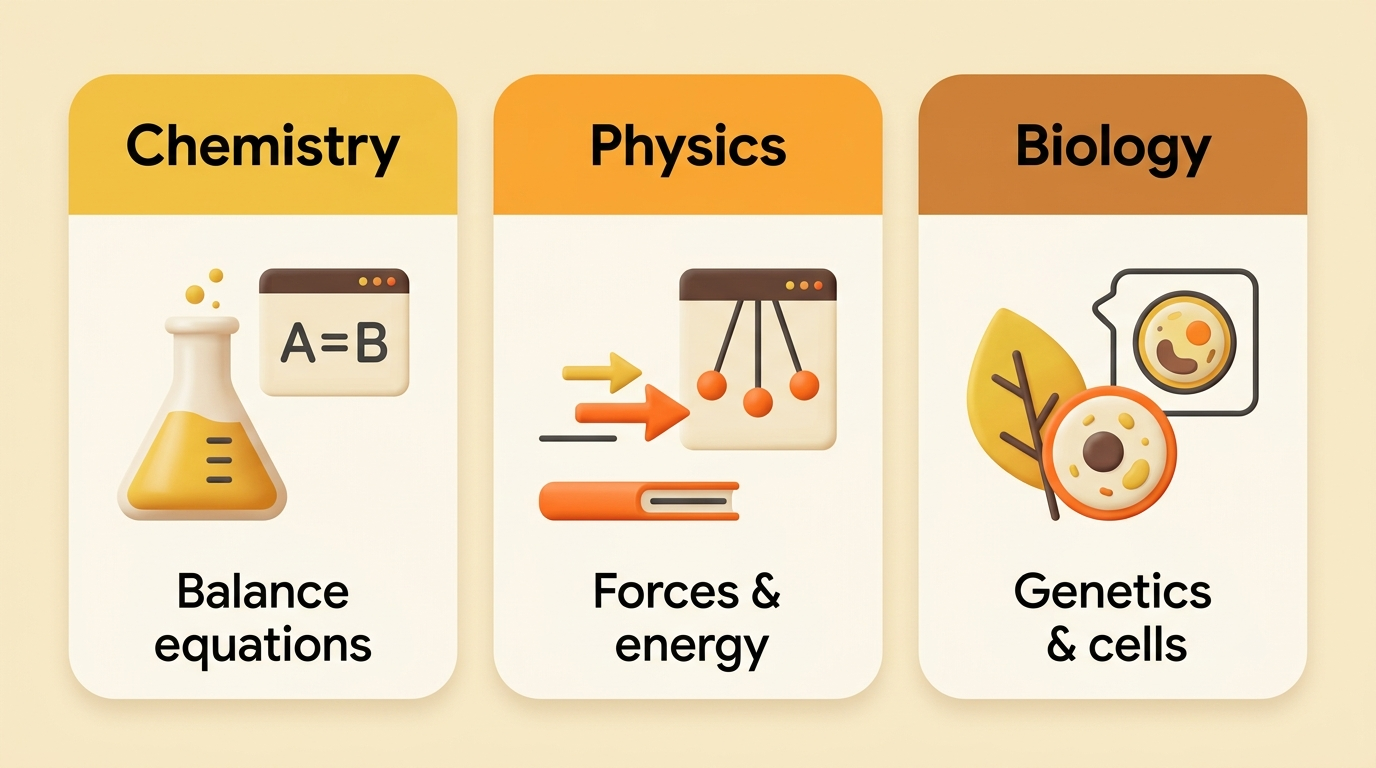
Which Science Subjects It Covers — Chemistry, Physics, Biology
Science homework help spans three core subjects, each with its own vocabulary and problem types, plus a few adjacent fields students bump into during general-science or earth-science units.
| Subject | Common topics | Typical task |
|---|---|---|
| Chemistry | Stoichiometry, molar mass, organic/inorganic reactions | Balance an equation, convert units |
| Physics | Kinematics, forces, energy, electromagnetism | Derive a formula, plug in values |
| Biology | Genetics, cell biology, ecology, anatomy | Explain a mechanism, solve a Punnett square |
| Earth science / Astronomy | Plate tectonics, weather systems, planetary motion | Interpret data, explain a process |
Chemistry
Chemistry coverage typically includes balancing equations, molar mass, stoichiometry, and reaction mechanisms across several branches:
- Organic chemistry — carbon-based compounds and reaction pathways
- Inorganic chemistry — salts, metals, and non-carbon compounds
- Physical and analytical chemistry — reaction rates, equilibrium, measurement
- Biochemistry — the chemistry underlying biological processes
A capable helper also handles the fiddly parts students lose points on — unit conversions, significant figures, and scientific notation — not just the headline reaction.
Physics
Physics problems range from kinematics and forces to energy, electromagnetism, thermodynamics, waves, and introductory nuclear or relativity concepts. Instead of just returning a number, a good AI science homework helper shows the formula derivation and walks through substituting each value, so you can see where the units come from.
Biology & Earth Science
Biology work covers cell biology, genetics (including Punnett squares), ecology, anatomy, and botany, while earth science and astronomy questions touch plate tectonics, weather systems, and planetary motion. The useful part isn’t labeling a diagram correctly — it’s explaining why a process happens, which is what turns a memorized fact into something you can apply on a test.
How It Works: From Photo to Step-by-Step Solution
Most tools accept several input formats, so you can use whatever’s fastest when you’re mid-assignment:
- A photo of a textbook page or worksheet
- A PDF upload
- Typed or pasted problem text
- A screenshot, in some tools
The steps that follow are the same regardless of how the problem gets in.
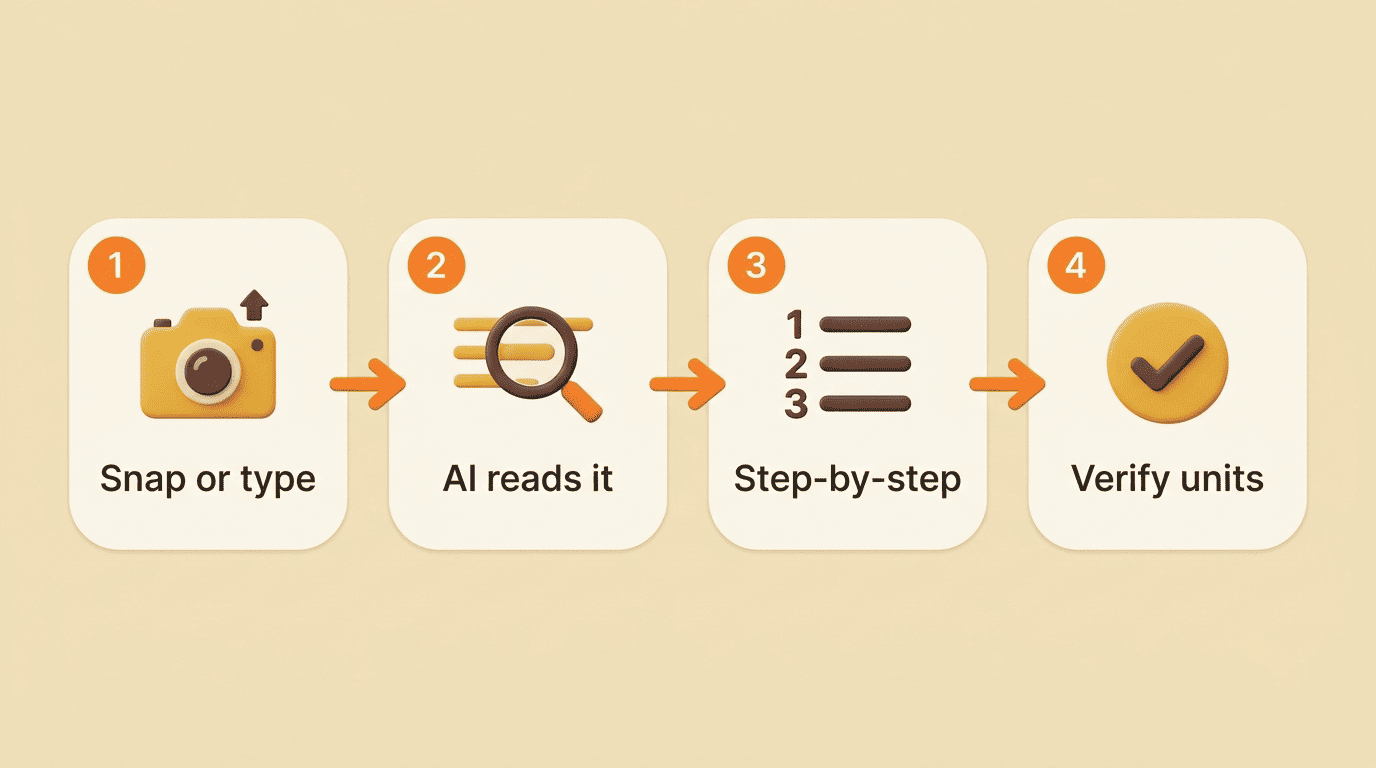
- Type or upload. Snap a photo of the textbook problem, upload a PDF, or paste the text directly.
- The AI reads it. Optical character recognition (OCR) extracts the problem from the image, including equations and diagrams where possible.
- It returns a worked solution. You get a numbered sequence of steps, not a single answer, usually within seconds.
- It verifies the result. Units get checked and the answer is confirmed against the original question before it’s handed back.
Kai then invites a follow-up question — something like «why did we divide here?» — because the conversation doesn’t have to end at step four.
A worked example (mini)
Take an unbalanced combustion equation: H₂ + O₂ → H₂O. A step-by-step helper doesn’t just balance it to 2H₂ + O₂ → 2H₂O; it explains why — because matter can’t be created or destroyed in the reaction, only rearranged.
The mass of an object or collection of objects never changes, no matter how the constituent parts rearrange themselves.
Encyclopaedia Britannica, «Conservation of Mass»
That law of conservation of mass is the actual reason the coefficients have to balance — not an arbitrary rule, which is exactly the kind of «why» a good explanation surfaces.
Using AI to Study Smarter — and Honestly
The most useful habit isn’t asking for a solved problem once and moving on — it’s using that solved problem as a template.
Turn solutions into practice. Once you’ve seen a problem worked step by step, redo it yourself from scratch without looking, then ask for a similar practice question to test whether it actually stuck. That loop — solve, redo, retest — is what homework help AI is built for: turning a single worked example into real test prep, with several tools generating unlimited variations of a problem type on request.
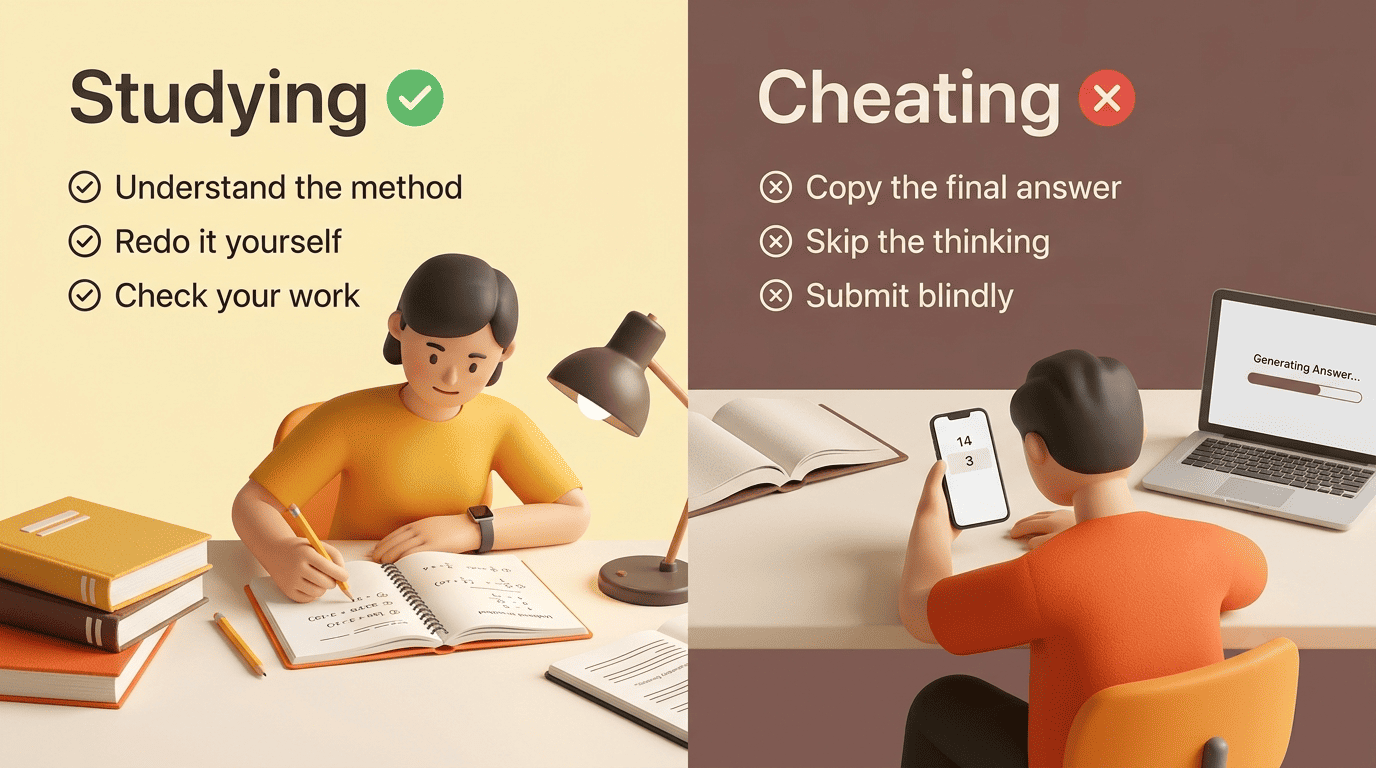
Know where the line is. Using AI to work through a problem and check your reasoning is studying. Copying a final answer straight into a graded assignment is where «help» turns into a problem — most schools treat submitting work you didn’t actually do or understand as an academic integrity violation, not a homework shortcut.
Cheating, plagiarism, unauthorized collaboration, and other forms of academic dishonesty are considered serious offenses for which disciplinary penalties can be imposed.
MIT Mind and Hand Book, Academic Integrity
Kai’s design nudges toward the same standard: it explains the reasoning, quizzes you back on it, and checks your work rather than just producing a final number to paste in. A quick way to keep yourself on the right side of that line:
- Use the explanation to understand the method, not to copy the final line
- Redo the problem yourself before it’s due
- Ask «why» whenever a step isn’t obvious
- Treat generated practice questions as rehearsal, not the graded submission
Is It Free, and How Accurate Is It?
Pricing and accuracy vary quite a bit between tools, so it’s worth knowing what you’re getting before you lean on one for a graded assignment.
Free vs paid tiers
Several tools are free with a daily cap — NoteGPT allows 20 tries a day with no sign-up — while others meter access behind a subscription, like ChemistryAI’s roughly $4.50–$6/month plans. Kai is available online with no upfront barrier, so you can try a real problem before deciding whether it fits your workflow.
| Tool | Access | Reported accuracy |
|---|---|---|
| NoteGPT | Free, 20 tries/day, no sign-up | — |
| StudyMonkey | Free tier | Answers in ~10 seconds |
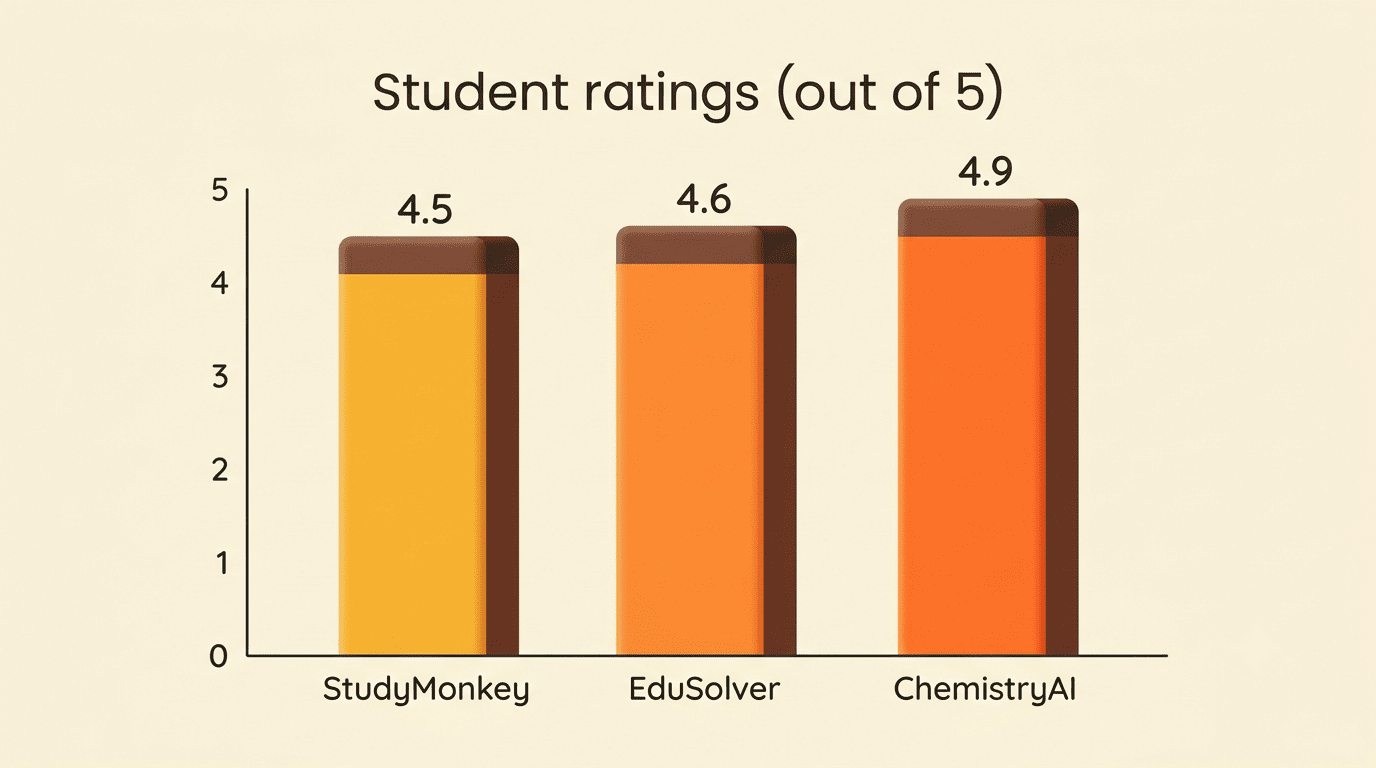
| EduSolver | Free tier | 4.6/5 across 120,000+ students |
| ChemistryAI | ~$4.50–$6/month | 4.9/5 from 151 reviews |
Always double-check
No AI is error-proof on an unusual or multi-part problem, so it’s worth checking the key step and the units yourself before you trust the final number. Treat the explanation as a way to confirm your understanding, not as an infallible answer key — that habit is exactly what keeps the tool working for your learning instead of around it.
Science homework rarely arrives one subject at a time, so it helps to have everything in a single homework help app — and you can start for nothing with free AI homework help before you ever pay.